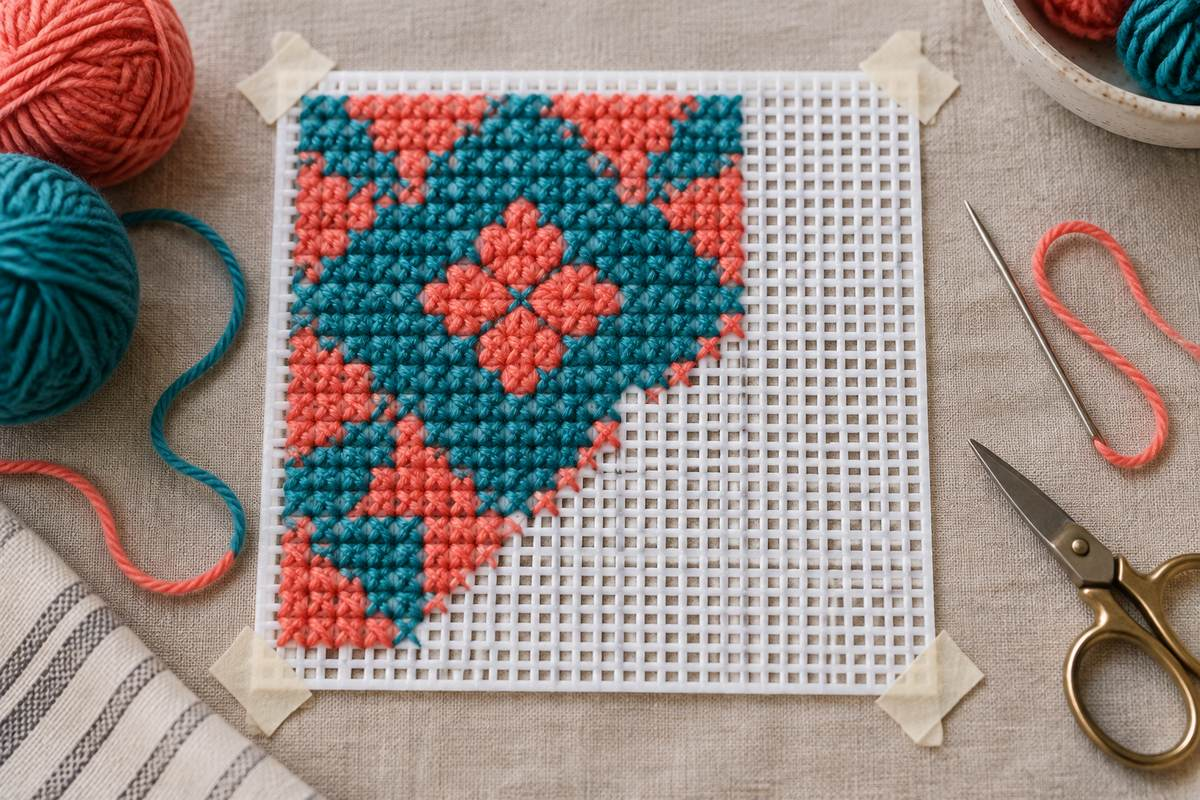
Cross stitch on plastic canvas uses the same X as fabric cross stitch, but the base is stiff, does not fray and can be cut into ornaments, magnets, boxes and other standing pieces. The key is buying the right canvas: choose 14-count perforated plastic with round holes for standard cross stitch. Square-holed plastic canvas is usually meant for yarn needlepoint and leaves gaps between crosses. Last updated November 5, 2026.
Start here: Pick a chart made from whole crosses and optional backstitch, 14-count round-hole perforated plastic, two or three strands of floss and a size 24 or 26 tapestry needle. Stitch in hand with extra plastic around the design. Cut afterward, leaving one whole bar outside every stitched edge.
Which plastic canvas to buy
Plastic canvas is a stiff sheet with a grid of holes. Floss Field lists common counts of 5, 7, 10 and 14 holes per inch. For cross stitch, 14 count is the practical standard because its stitch size matches 14-count Aida.
The hole shape matters more than the package wording. Notorious Needle and Gathered both distinguish square-holed plastic canvas from perforated plastic with round holes. Square holes are common on 5, 7 and 10 count canvas intended for yarn needlepoint. They can leave visible gaps between cross stitches. Round-hole perforated plastic lets crosses sit close together and is less likely to snag floss.
Clear and white are the easiest colors to find. Clear disappears behind most thread colors; white can look deliberate behind pale designs. For the yarn version, see our plastic canvas needlepoint guide.
Patterns that work
Gathered and Notorious Needle agree on the basic rule: choose a chart with whole cross stitches and, optionally, backstitch. Fractional stitches do not fit the rigid grid cleanly. French knots are usually avoided for the same reason, although Needlepointers quotes a tip for very small knots over already stitched plastic. Treat that as an advanced exception, not a beginner plan.
Full-coverage designs with simple outlines work best because large areas of bare plastic are visible and the finished piece has to be cut out. Good starter projects include ornaments, magnets, keychains, cake toppers and small box panels. Floss Field's size math is unchanged: divide the chart's stitch count by the canvas count. A 42-stitch-wide design is 3 inches wide on 14 count, 4.2 inches on 10 count and 6 inches on 7 count.
Three-dimensional patterns need pieces whose holes align at the seams. Keep the chart simple until you have joined one flat project successfully. Our cross stitch size calculator can check the finished panel size before you cut.
Thread and needle
On 14-count plastic, Floss Field recommends two or three strands of embroidery floss. Two strands pull through more easily; three may cover the plastic better. Gathered suggests three or four strands for overstitching edges on 14 count. Notorious Needle uses heavier coverage on lower counts, including six strands on 10 count and yarn on 5 count.
Use a blunt tapestry needle, usually size 24 or 26 on 14 count. Plastic does not flex like cloth, so Notorious Needle recommends choosing the smaller needle when you are between sizes. Test the threaded needle through an empty hole before starting; it should pass without scraping the floss.
How to stitch it
Stitch in hand. You cannot put a rigid sheet in a hoop or fold it to find the center. Gathered recommends measuring both dimensions and marking the center with a pin or needle. Leave at least 3 cm, about 1 1/4 inches, of spare plastic around the design so you have something to hold.
Start without a knot. Hold the tail against the back and cover it with the first few stitches. Work the crosses just as you would on Aida, keeping tension even. End by running the needle under four or five stitches on the back and trimming close. Floss Field warns that burying under the front can lift the stitches; use the back.
If several pieces share one sheet, Notorious Needle advises leaving at least two bars between them. That preserves one full bar around each piece after cutting.
Cut without losing stitches
Count bars, not holes. Notorious Needle's cutting rule is to leave one complete bar of plastic outside the stitches on every side. That bar holds the outer row together. Never cut through a hole that contains thread.
Stitch first, then cut, unless a chart gives a tested cutting line. Gathered recommends cutting freehand slowly with old scissors, not fabric scissors. Trim bumps along the edge and soften sharp corners. Floss Field gives the same rule: one whole bar all the way around, and never into a threaded hole.
If you must cut before stitching, mark the shape with a dry marker and check it twice. When in doubt, leave the sheet large. Extra plastic can be removed later; a missing bar cannot be put back cleanly.
Edges, backs and 3D pieces
An overcast stitch covers a bare edge. Bring the needle over the edge and down through the next hole, repeating around the piece. Gathered uses three or four strands on 14 count for coverage. Notorious Needle adds extra passes at outer corners and fewer at inner corners so the edge is covered without bunching.
The same motion through two aligned pieces becomes a joining or whip stitch for boxes and standing shapes. Floss Field notes that a felt backing hides the thread ends on flat pieces. For seasonal projects, our cross stitch ornament guide covers backing and hanging choices.
Where sources disagree
Is square-holed plastic usable for cross stitch?Notorious Needle says square holes are not ideal because they can leave gaps; Gathered says they will not give the best finish. Floss Field says lower-count square-hole canvas can be cross stitched, but each cross is much bigger and needs more thread. For standard cross stitch, round-hole 14 count is the safer choice.
Should you cut before or after stitching?Notorious Needle prefers cutting after stitching and leaving spare bars between pieces. Gathered also starts with extra canvas and cuts afterward. Some patterns include a cutting line for pre-cut pieces. Follow a tested pattern line; otherwise stitch first.
How many strands cover 14 count? Floss Field gives two or three for the crosses. Gathered gives three or four for edge overstitching. Notorious Needle uses four strands with a size 24 needle on its 14-count example. Coverage and ease pull in opposite directions; test a small patch.
Can you add French knots? Gathered says choose whole crosses and backstitch because French knots do not work on plastic canvas. Needlepointers includes a tip for small knots over stitched plastic with a fine needle. The difference is the base: knots over existing stitches may hold, while knots into bare holes have nothing to grip.
FAQ
What count plastic canvas is best for cross stitch?14-count perforated plastic with round holes. It matches the stitch size of 14-count Aida and works with ordinary stranded floss.
Can any cross stitch pattern go on plastic canvas?No. Use whole crosses and optional backstitch with a simple outline. Avoid fractionals, heavy negative space and charts that need a shaped fabric edge.
Do you use a hoop with plastic canvas? No. The sheet is stiff enough to stitch in hand. Leave extra plastic around the design for your fingers.
How much plastic should you leave around the stitches?Leave at least 3 cm while stitching, then cut to one complete bar outside the stitched shape. Do not cut into a threaded hole.
How do you hide the back? End threads under stitches on the back, then add felt to a flat ornament or magnet. Three-dimensional pieces usually hide the backs inside the joined shape.
Can plastic canvas be washed? It is durable, but the thread and any glued felt may be less durable than the plastic. Spot clean gently and test adhesives and dyed threads before soaking a finished piece.
Sources
- Notorious Needle - Guide to Cross Stitch on Plastic Canvas (a cross-stitch designer and tutorial site; perforated plastic, needles, cutting, joining and overcasting)
- Gathered - The Ultimate Guide to Plastic Canvas for Cross Stitch (a craft magazine guide, updated November 2025; pattern choice, centering, cutting, overstitching and whipstitching)
- Floss Field - Cross Stitch on Plastic Canvas (a cross-stitch educational reference; counts, sizing, thread, cutting and backing)
- Needlepointers.com - Plastic Canvas Tips and Tricks (a needlework educational directory, updated March 2025; reader and publisher tips on edges, repairs, tension and materials)
- Caterpillar Cross Stitch - How to Cross Stitch on a Plastic Canvas Ornament (a cross-stitch kit seller; ornament materials, felt backing and hanging finish)