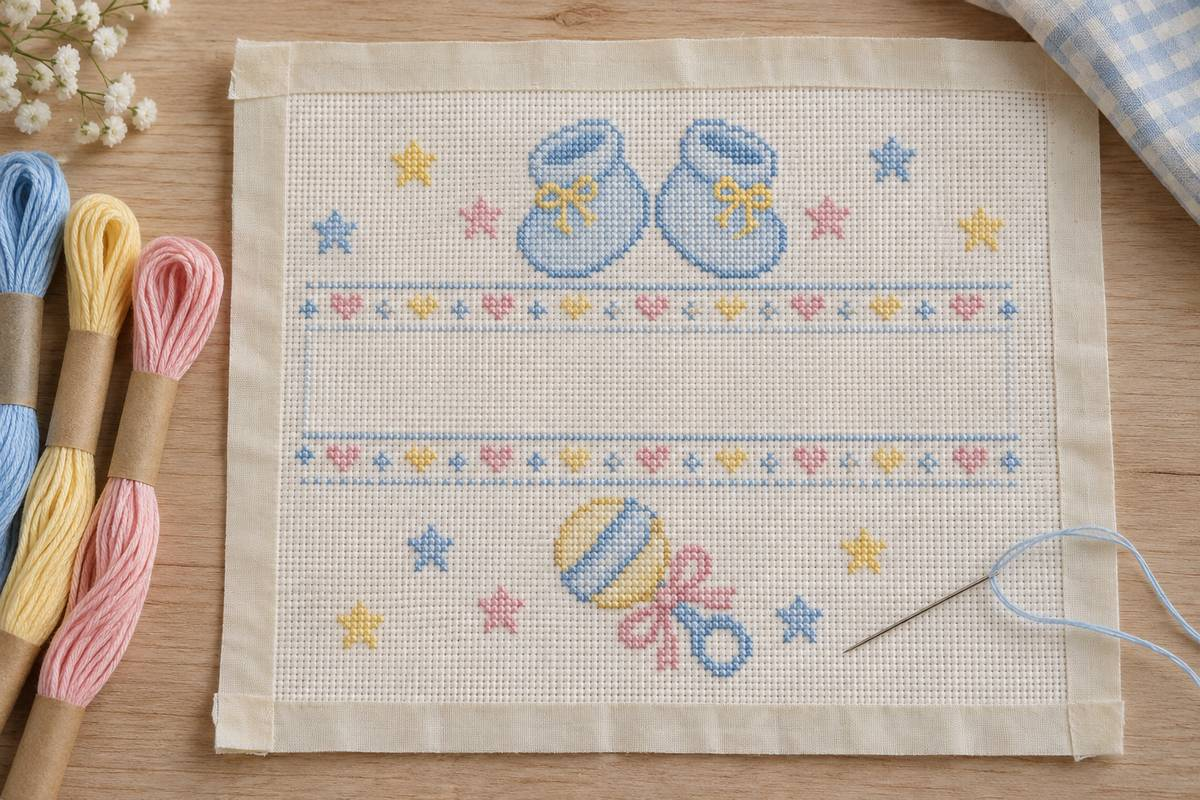
A cross stitch birth sampler is a small stitched record of a new baby: a name, a birth date and, if the family wants them, a time, a weight and a length, framed by a motif that suits the nursery. It is a gift with a built-in deadline and one unforgiving detail, because a misspelled name cannot be unpicked gracefully. This guide covers what to put on it, how to size it, how to schedule the stitching around a due date that may move, and how to finish it. Last updated November 13, 2026.
Start here: Confirm the exact spelling of the name before you chart anything, and stitch the artwork and border first. Leave the name and date for last, because a baby can arrive earlier or later than the due date. Work out the finished size from the stitch count before you buy fabric.
Birth announcement, birth sampler or name sampler
These terms overlap and shops use them loosely. Simone Balman Art, a pattern seller, sorts them this way. A birth announcement has spaces for the baby's name, date of birth and often weight and length, and reads like a stitched version of the card you would mail out. A birth sampler is the same idea with a more traditional look, usually a border, an alphabet or a row of small motifs around the text. A name sampler is centered on the name alone, sometimes with a short verse, and is quicker to stitch and easier to personalize.
If time is short, a name sampler is the most forgiving choice. If the family will frame it and keep it, a fuller piece with the date and measurements tells the story of the day. Both are small projects by cross stitch standards, and both are mostly lettering, which is where the care goes.
What goes on it
Decide what the piece says before you pick a pattern, because the text takes up much of the chart and sets the finished size.
- The full name. Confirm the spelling with the parents, including middle names, hyphens and accents. Simone Balman Art calls this the one detail you cannot fix after stitching.
- The date. Spelling the month out, as in October 21, 2026, looks tidier and more traditional than 10/21/26, and it avoids confusion for relatives who write the day before the month.
- Optional extras. Time of birth, weight, length, place of birth and a short phrase. Ask gently, because some families do not track every detail. Keep any phrase short so the text stays legible at small sizes.
Stitchxcross, which sells a sampler generator, gives the same advice in a different order: settle the wording first, put names on one line and a short date beneath, and decide up front whether you want all capitals or mixed case, because not every alphabet includes lowercase. Our cross stitch alphabet maker guide is a good place to start on lettering.
Pick a motif that fits the room
The artwork sets the mood, so think about the nursery as well as your own taste. Simone Balman Art's list is a useful starting point: baby shoes or tiny feet for a classic gender-neutral keepsake, animals for a playful room, flowers for a calm one, coastal scenes for blue-and-white rooms, and sun, moon and stars for neutral spaces, which often need fewer colors. Detailed fantasy or storybook scenes are bigger projects, so check the stitch count first.
Craft with Cartwright, a designer's site, offers a free unisex birth sampler as an example of the traditional format. It has a bubble border, footprints, rattles, a pram, a mobile, a pacifier and booties, a design area of 111 by 160 stitches, and 17 DMC colors, with space left for names, weights and dates. A chart like that shows the usual layout: busy motifs around the edge and a clear zone for the text.
Plan the size before you buy fabric
The size arithmetic is simple. Finished size in inches equals the stitch count divided by the fabric count, where the count is how many stitches fit in an inch. Simone Balman Art works an example: a pattern 112 stitches wide and 140 tall on 14-count Aida is 8 by 10 inches. The same pattern on 18-count would be about 6.2 inches wide.
Then add margin for framing and finishing. Simone Balman Art suggests a generous 3 inches on each side, so that 8 by 10 design needs fabric at least 14 by 16 inches. The Craft with Cartwright design above, at 111 by 160 stitches, works out to 7.93 by 11.43 inches on 14-count, which matches its published design area. Stitchxcross gives a shorter example: a design 70 stitches wide is 5 inches wide on 14-count, before blank margins.
Our cross stitch size calculator guide and Aida count guide cover related sizing questions, and gridding the fabric helps keep long text lines straight on large pieces.
Fabric count is a trade-off. Fourteen-count Aida is easy to see and count and is the usual beginner choice. Sixteen or 18-count gives smaller stitches and more detail but is harder on the eyes. Evenweave or linen has a softer vintage look, stitched over two threads, and takes practice. White or cream is the classic ground. A soft pastel adds warmth, but your thread colors will look different against it.
Schedule it around a moving due date
A due date is an estimate. Simone Balman Art notes that a full-term pregnancy is counted as about 280 days from the first day of the last period, and that a baby can arrive earlier or later than expected. That is why the order of stitching matters more here than on most gifts.
A workable schedule, adapted from Simone Balman Art's:
- Eight to ten weeks ahead: choose the pattern and gather fabric, floss, needles and a hoop or frame.
- Next several weeks: stitch the artwork and border and leave the name and date areas empty.
- After the birth: stitch the personal details, then check the spelling against the parents' own message.
- One to two weeks before gifting: wash if needed, press and frame.
If the baby has not arrived and the parents have not chosen a name, or want to keep it private, stitch everything except the personal details and fill those in afterward. For your own pace, our guide to how long cross stitch takes shows how to turn a stitch count into hours.
Stitch the lettering carefully
Text is where mistakes show. Fold the fabric in half both ways and match the center to the chart center. Stitch the largest color blocks first, then the details. Count the width of the name in stitches and find its center so the letters sit evenly, which matters most for long names. Check each letter against the chart before moving on.
Stitchxcross adds practical checks for the lettering stage: look at spaces inside letters, narrow joins and the date numerals on the actual stitch grid, because raising the height can also raise the width. Use fresh thread for the text, and buy all the floss for the personal details at the start, since a dye lot bought weeks later can differ slightly. Our strands guide and floss calculator guide help you buy the right amount once.
Balance matters as well. Center alignment is a good default for names and a date, though stitchxcross treats it as a starting point rather than a rule. Leave empty stitches between the text and any border so both stay readable, and use a small heart or geometric frame in one or two colors rather than filling every gap with motifs.
Finish and give it
Wash if needed, press and frame. Our guides on washing finished cross stitch and framing cover the details, and a hoop finish is a quick option for a small name sampler. Simone Balman Art notes that 8 by 10 is a standard frame size that is easy to find.
If the piece is part of a bigger present, our cross stitch gift ideas has more ideas, and our wedding record guide covers centering names and dates on a larger piece.
Where sources disagree
Traditional or modern. Simone Balman Art leans toward artwork that fits a real nursery and says a modern look suits more rooms, while Craft with Cartwright's free pattern shows the busier traditional format with a bubble border and many small motifs. Both work. The choice depends on the room and the family, not on a rule.
How much to include. Simone Balman Art lists weight, length, time and place as nice extras. Stitchxcross, writing about name and date samplers generally, keeps the wording concise so it stays legible at the size you want to frame. For a small piece, fewer lines read better, so include only what will stay readable.
Centering. Simone Balman Art tells you to find the center of the name so letters sit evenly. Stitchxcross calls center alignment a useful starting point but not required. For a formal keepsake, centered text is the safer default.
FAQ
What is the difference between a birth announcement and a birth sampler? Shops use the terms loosely. In Simone Balman Art's description, an announcement has spaces for name, date and measurements, while a sampler usually has a more traditional look with a border or alphabet.
When should I start? About eight to ten weeks ahead of the gift date, with the artwork first and the personal details last, per Simone Balman Art's schedule.
What if the baby is not born yet? Stitch everything except the personal details and fill those in after the birth. A due date is only an estimate.
How big will it be? Divide the stitch count by the fabric count. A 112 by 140 pattern on 14-count Aida is 8 by 10 inches before margins, and Simone Balman Art suggests 3 inches of extra fabric on each side.
Can a beginner do it? A name sampler on 14-count Aida is a reasonable first lettering project. Take your time with counting, and check every letter against the chart.
Can I stitch the name in lowercase? Only if your alphabet has it. Stitchxcross notes that not every alphabet includes lowercase, so check before you commit.
Sources
This guide draws on the following sources. Where their advice differs, it says so above rather than blending them.
- Simone Balman Art, cross stitch pattern seller: Birth Announcement Cross Stitch: Plan, Stitch and Gift, simonebalman.com. Source for the announcement, sampler and name sampler distinctions, the text checklist, the motif table, the size example, the schedule and the 280-day due date note. This is a seller's guide and its advice stands on its own.
- Stitchxcross, sampler pattern tool seller: How to make a cross stitch name and date sampler, stitchxcross.com. Source for the wording-first workflow, alphabet and lowercase cautions, alignment, spacing and border advice, and the 70-stitch sizing example.
- Craft with Cartwright, pattern designer: Free birth sampler cross stitch pattern, craftwithcartwright.co.uk. Source for the example design, its dimensions and its color count.