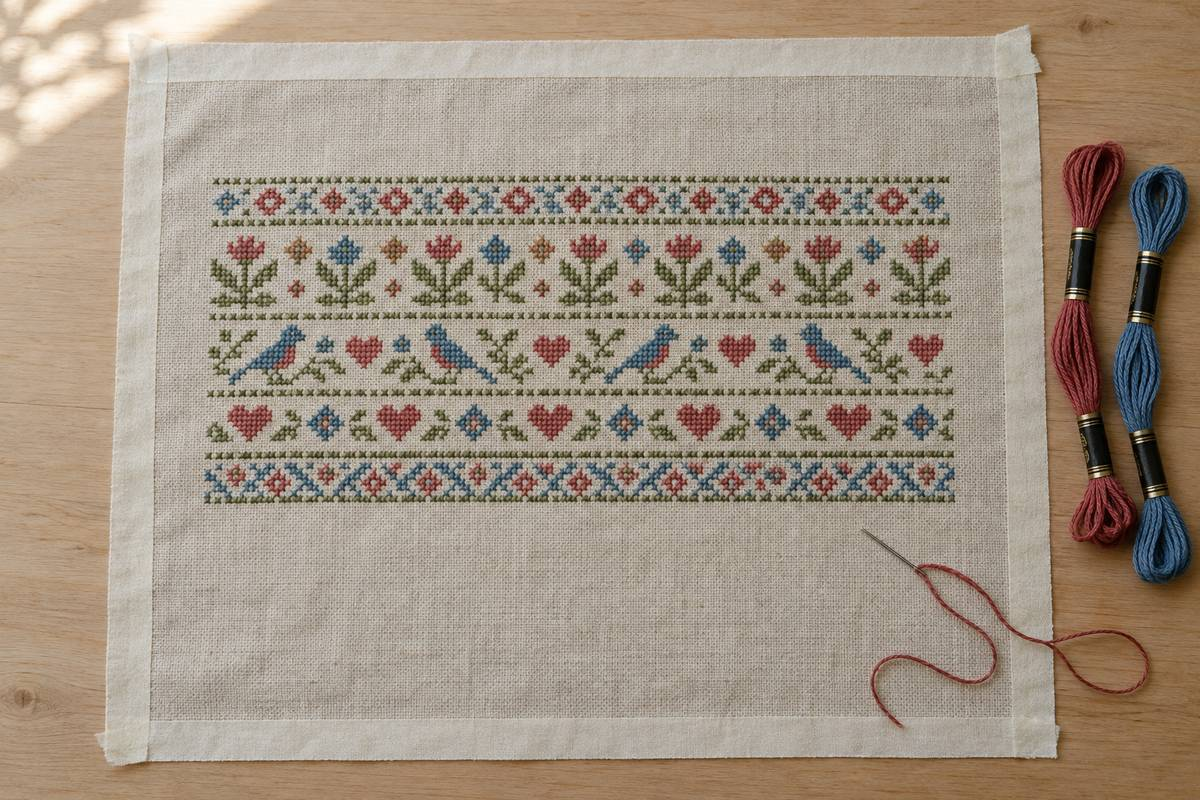
A cross stitch sampler is, at its simplest, a sample: a piece of fabric that collects stitches, letters and motifs in one place. For roughly four centuries it was how stitchers recorded patterns they wanted to keep, and then how girls proved they had learned to sew. Today it is the most recognizable format in the hobby: an alphabet, a border, some motifs, a name and a date. This guide covers what a sampler is, where the format came from, what the classic ingredients mean, and how to stitch a modern one. Last updated November 14, 2026.
Start here: The word sampler comes from the Latin exemplum, an example. Everything about the format follows from that: it began as a reference you consulted, became a school exercise you displayed, and survives as a style you can stitch today. If you want to try one, start small: a row of alphabet, your name and the year is a faithful mini sampler, not a watered-down one.
What a sampler actually is
Counted and Crossed, a cross stitch education site, gives the cleanest modern definition: a sampler is a sample of stitches, letters and motifs, part reference document and part rite of passage. The Victoria and Albert Museum, which holds more than 700 needlework samplers, traces the English word to the Latin exemplum and the old French essamplaire, both meaning an example.
That origin explains the format. Before printed patterns existed, a stitcher who saw a new stitch or motif sewed a small copy of it onto cloth, building a personal reference work to consult later. The sampler was not made to be admired; it was made to be used, the way you would keep a recipe card rather than frame it.
Where samplers came from
The urge to record stitches is old. Wikipedia's sampler article notes the earliest surviving example is a spot sampler from the Nazca culture of Peru, estimated at roughly 200 BCE to 300 CE, and that Coptic sampler fragments survive from Egyptian burial grounds of 400 to 500 CE. The V&A's oldest pieces are Egyptian, probably 14th or 15th century.
European samplers appear in records before surviving examples: a 1509 inventory of Queen Joanna of Castile's possessions listed fifty dechados, the Spanish word for samplers. The first printed pattern book appeared in Germany in the early 1520s, but for centuries most stitchers still relied on stitched examples. The earliest known dated English sampler was made by Jane Bostocke in 1598, and it already shows the format's double life: part reference, part record, since its inscription commemorates the birth of a child, Alice Lee, two years earlier.
Spot samplers, band samplers and the schoolroom
Through the 17th century, the V&A describes two layouts. Spot samplers scattered individual motifs randomly across the fabric, closer to the old reference purpose. Band samplers arranged repeating border patterns in orderly horizontal rows, and by about 1630 they had a recognizable long, narrow shape. Fabric was expensive, so band samplers were densely covered and highly valued, sometimes mentioned in wills.
Then the purpose shifted. The V&A traces how 17th-century samplers moved from personal reference works to practice pieces for girls learning needlework, and the Milwaukee Public Museum describes what that became: by the 18th century the sampler was a schoolroom tool, as standard as a slate. A girl's sewing education usually began with a marking sampler: cross stitched alphabets, numerals and a few simple motifs in ordered rows, practice for labeling household linen. More accomplished students moved on to pictorial pieces with houses, gardens, maps and verses.
By the 19th century, the V&A notes, the English schoolroom sampler was worked almost exclusively in cross stitch, which is why the format and the stitch are now inseparable in most people's minds.
Samplers as records of lives
Because samplers were signed and dated, they outlived their makers as evidence. The National Archives holds six samplers inside Revolutionary War pension files, submitted by veterans' widows and children as legal proof of births and marriages when no official records existed. One was stitched by Martha Earl around 1787, when she was about six. Another, made by ten-year-old Mary Hearn of Nantucket in 1793, was reworked by Mary herself decades later to alter her birth date, a change she had to explain to the Pension Office.
Counted and Crossed makes the quieter point: for eras when most women left few written records, a signed sampler is sometimes the only surviving trace of a particular girl's existence. The popular stitched verse "When this you see remember me" was not morbid decoration; it was the hope that the work would outlive the worker. That record-keeping instinct survives today in the family occasions samplers still mark: our birth sampler guide and wedding record guide are direct descendants of the genre.
Stitching a sampler today
Modern samplers split into a few routes, per Wikipedia's overview: kits from needlework shops, chart packs, and the huge range of patterns from independent designers, from faithful reproductions of historic pieces to contemporary and even subversive styles. Popular subjects include births and marriages, family trees, mottoes and maps. Complexity ranges from single-stitch beginner pieces to advanced samplers using 15 or 20 different stitches.
Counted and Crossed's starter suggestion is worth taking literally: one alphabet row, your name and the year is a real sampler in miniature. From there, a band layout of small motifs is the classic next step. Our alphabet maker guide handles lettering, the size calculator plans the fabric, and designing your own pattern covers charting a layout of your own.
Where sources disagree
What counts as a sampler. Wikipedia cautions that the word is sometimes applied loosely to any needlework meant for display, and treats the genre broadly as any needlework in sampler style, with or without lettering. Counted and Crossed insists on the reference roots: an alphabet, motifs and usually a border. For a stitcher today, the practical line is intent: a piece that demonstrates or collects techniques is a sampler; a single picture is not.
A reference or a display piece. The V&A emphasizes that early samplers were working references, consulted rather than framed. The Milwaukee Public Museum shows that by the 18th century they were made to be displayed as public proof of a girl's accomplishment. Modern samplers are almost entirely the second kind, but choosing motifs you want to learn keeps a little of the first purpose alive.
How old the tradition is. The V&A's story starts with its 14th and 15th century Egyptian pieces, while Wikipedia reaches back to the Nazca spot sampler of roughly 200 BCE to 300 CE and Coptic fragments of 400 to 500 CE. The difference is definition, not dispute: how loosely you count early pattern-darning fragments as samplers.
FAQ
What is the point of a sampler? Historically, to record stitches and motifs for later use, and then to demonstrate a girl's needlework education. Today, mostly to celebrate the format itself: alphabets, borders and motifs in one frameable piece.
Why do samplers have alphabets? Alphabets were practice for marking household linen with names and initials, and a reference of letterforms for future work. They survive as the format's most recognizable ingredient.
What is the oldest known sampler? It depends on definition. Wikipedia cites a Nazca spot sampler from Peru dated roughly 200 BCE to 300 CE; the V&A's oldest are Egyptian, probably 14th or 15th century; the earliest dated English sampler is Jane Bostocke's 1598 piece.
Are samplers good for beginners? Yes. A marking-style sampler, alphabets and numerals in rows, was literally the beginner's exercise for two centuries. One alphabet row plus a name and date is a faithful small start.
What is a marking sampler? The Milwaukee Public Museum's term for the simplest school exercise: cross stitched alphabets, numerals and a few small motifs in ordered rows, teaching the stitches used to mark clothing and linen.
Sources
This guide draws on the following sources. Where their advice differs, it says so above rather than blending them.
- Victoria and Albert Museum, London: Embroidery: a history of needlework samplers, vam.ac.uk. Source for the word origin, the reference-work purpose, the 1598 Jane Bostocke sampler, spot and band layouts, and the shift to schoolroom cross stitch.
- Wikipedia: Sampler (needlework), en.wikipedia.org. Source for the Nazca and Coptic early examples, the 1509 Castile inventory, the first pattern book, and the overview of modern samplers.
- Milwaukee Public Museum: The ABCs of Schoolgirl Samplers, mpm.edu. Source for the marking sampler, the sampler as a standard schoolroom tool, and the decline of sampler making in the 19th century.
- National Archives: Remember Me: Six Samplers in the National Archives, archives.gov. Source for the pension-file samplers, the Martha Earl and Mary Hearn examples, and the "remember me" verse.
- Counted and Crossed, cross stitch education site: What Is a Cross-Stitch Sampler?, countedandcrossed.com. Source for the modern definition, the core ingredients list, the only-trace-of-a-life point, and the mini-sampler starter project.