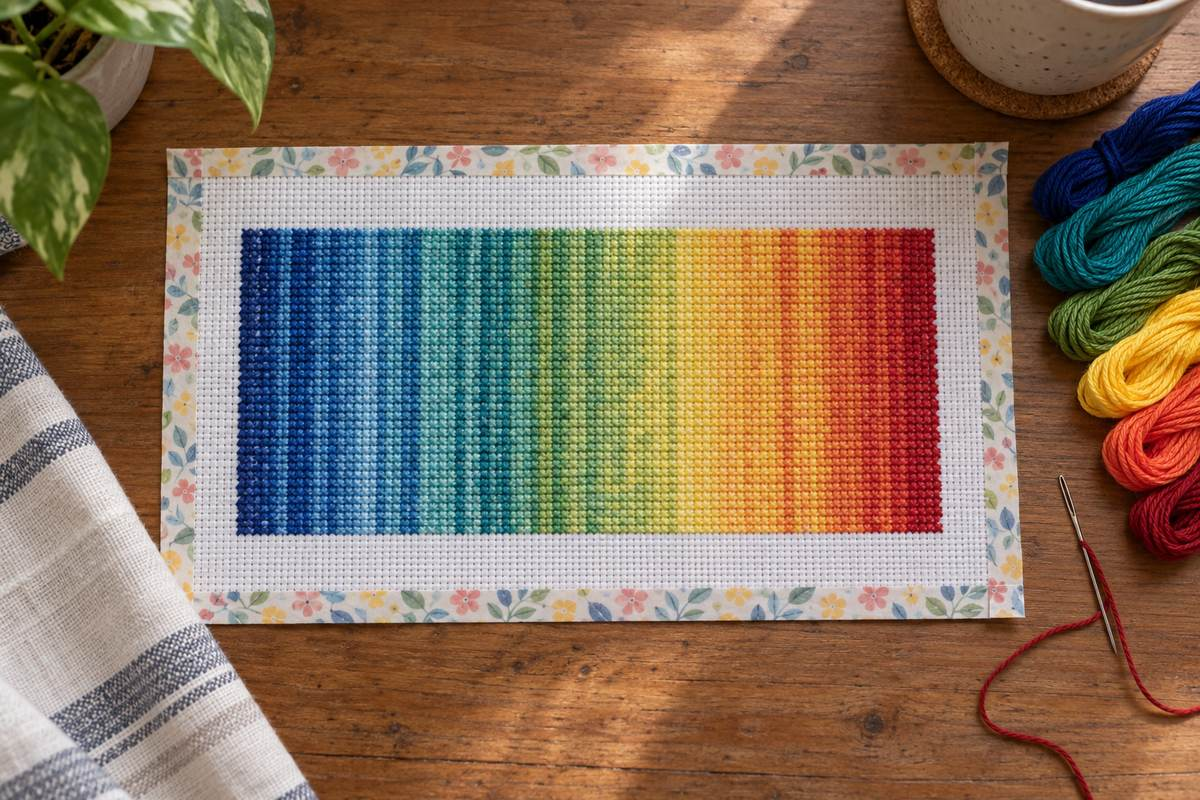
A temperature cross stitch turns a year of weather into a pattern: each day gets one stitch or small block in the color assigned to that day's temperature. You set the color key and layout before you start, record a reading every day, and stitch in weekly batches. This guide covers readings, color keys, layouts, supplies and the points where pattern makers disagree. Last updated November 16, 2026.
Start here: The two decisions that matter are made before January 1: which reading you will record (high, low or average) and which colors stand for which temperature ranges. Everything else is a weekly habit. Mid-November is the right time to gather floss and chart your layout for a January 1 start.
What a temperature cross stitch is
A temperature project is a record of the weather kept one day at a time. Before starting, you divide the temperatures your year is likely to span into ranges and give each range a thread color. Every day then gets its own place on the cloth, stitched in the color of that day's reading. Knitters and crocheters keep the same record as a temperature blanket worked a row a day; in cross stitch a day is a single cross, a small block of stitches or a tiny repeated motif.
By December the fabric shows the year: the cold snaps, the first warm week of spring, the July heatwave. Because the colors follow your local weather, stitchers in different places can produce very different pieces. Many people stitch one as a stitch along with friends or an online group, and our stitch along guide explains how those groups run.
Choose your reading and source
Pick one reading and keep to it all year: the daily high, the daily low or the daily average. Hoop and Hearth recommends the daily high for a first year because it is the simplest to find. Craft with Cartwright's free tracker pattern uses the daily average, and Fat Quarter Shop's heart design accepts either the average or the maximum. Satsuma Street's Local Conditions chart uses the high. Any of them works; mixing them does not.
Use one source and one weather station for the whole year. Your weather app shows today's figures, and national services publish daily records: the National Weather Service in the US, the Met Office in the UK and Environment and Climate Change Canada all keep historical data you can look up later. That history is what makes a missed week recoverable.
Setting the color key
The key is the heart of the project. Floss Field's planning guide gives the method: look up last year's coldest and hottest readings for your place to find the span your key must cover, choose how many colors you want, then divide the span into equal ranges. A 30 degree span across six colors gives 5 degree bands. In a mild climate where the temperature hardly moves for months, narrower bands bring out the changes; wide bands would give long stretches of one color.
The usual scheme runs cool to warm: blues through greens and yellows to reds. Hoop and Hearth publishes a free eleven color DMC key running from navy for 13°F and below to dark red for 95°F and above, with Fahrenheit and Celsius bands that line up because a 5°C step equals a 9°F step. Lay your skeins side by side before committing: neighboring colors must be easy to tell apart under a lamp at night, and no color should match your fabric. Write the key down with thread numbers and keep it with the project.
Layouts and sizes
The plainest layout is one row per month, one stitch per day: 31 stitches wide and 12 rows high, with the extra squares left empty in shorter months. Hoop and Hearth charts three workable layouts: month rows at 31 x 12 stitches (about 2.2 x 0.9 inches on 14 count), month rows of 2 x 2 blocks at 62 x 35 including gaps between month rows (about 4.4 x 2.5 inches), and calendar weeks with seven stitches per row. Floss Field's size table adds the 3 x 3 block (93 x 36) and 5 x 5 block (155 x 60) versions, and notes that the layout can just as well run as month columns or one long band.
Ready-made charts handle the layout for you. Craft with Cartwright's free download comes in 365 and 366 day versions with or without backstitch, sized 141 x 73 stitches. Satsuma Street's Local Conditions is 95 x 174, about 7 x 12.5 inches on 14 count, and includes alphabet charts to add your place and year. Whatever you choose, draw the layout on a grid first so you know its size in stitches before cutting fabric: our graph paper guide covers sketching it, and the size calculator converts stitches to fabric with margins. Three inches of extra fabric on every side is the usual framing allowance. Marking the cloth with a grid, or at least where each month starts, saves counting from the edge all year; see how to grid fabric.
Thread and supplies
The supply list is short. Craft with Cartwright calls for 14 count aida, an embroidery hoop, DMC floss, a size 24 needle and scissors. Fat Quarter Shop's version uses 25 count Lugana stitched over two with a size 26 needle and a pack of 23 DMC colors. Satsuma Street lists 33 shades but notes the number you actually need depends on your climate.
A year is fewer stitches than it sounds. Floss Field estimates one skein of stranded cotton makes about 2,000 whole crosses on 14 count with two strands, so even the 2 x 2 block layout, about 1,460 stitches across all colors, needs only one skein of each color. Buy every color in the key at the start, since you cannot know in advance which colors your weather will use most, and keep the numbers written on the key so any of them can be matched again. Our floss calculator explains the skein math in more detail.
Keeping up all year
Every guide lands on the same habit: record daily, stitch weekly. Write the reading down every day, even when you do not stitch; a line on paper or in a notes app takes ten seconds. Then pick a regular slot, like Sunday evening, and stitch the week's seven days in one sitting. Fat Quarter Shop ran its stitch along exactly this way, stitching the previous week every Sunday. At the 2 x 2 block size that is 28 stitches a week, roughly ten minutes at 200 stitches an hour, before setup and thread changes.
If you fall behind, look the missing days up in your weather history and catch up; nothing is lost. You can also start late: backfill the earlier days from historical records, or start on any date and run twelve months from there to mark a year that matters. Keep the log somewhere you already go every evening, and mark off each stitched day so you always know where you are.
Where sources disagree
The reading is the first split. Craft with Cartwright and one Fat Quarter Shop option use the daily average, Satsuma Street uses the high, and Hoop and Hearth recommends the high for simplicity while allowing any consistent choice. The average smooths the year; the high is easier to look up. What breaks a chart is switching mid-year, so decide once.
Color counts vary widely: Floss Field describes projects from about six colors upward, Hoop and Hearth's free key uses eleven, Fat Quarter Shop's heart uses 23, and Satsuma Street lists 33. Fewer colors look bold and graphic and are simpler to shop for; more colors give a smoother gradient. Layout orientation differs too, with month rows, month columns, calendar weeks and single bands all in use, and leap years are handled differently by different patterns, so check that a ready-made chart matches the year you plan to stitch.
FAQ
Should I record the high, low or average? Any of them, as long as you use the same reading from the same source all year. The daily high is the easiest to find; the average gives a smoother picture of the day.
What fabric should I use? 14 count aida in white, cream or pale grey is the standard choice because the colors read clearly and the holes are easy to count. Evenweave or linen over two works the same way; Fat Quarter Shop's pattern uses 25 count Lugana with a size 26 needle.
How much floss do I need? For the small layouts discussed here, one skein per color is a reasonable starting estimate. Floss Field estimates about 4.6 skeins in total for its 25-stitch-per-day layout; at that size, a color used on more than about 80 days may need a second skein. Larger decorative charts need their own thread estimate.
Can I start after January 1? Yes. Fill in the missed days from your weather service's historical data, or start on any date and stitch twelve months from there. A year does not have to mean a calendar year.
Sources
Floss Field, cross stitch planning guides: How to plan a temperature cross stitch
Hoop and Hearth, pattern designer: Temperature chart guide with a free DMC color key
Fat Quarter Shop, fabric and craft retailer: Temperature cross stitch 101
Craft with Cartwright, designer blog: Free temperature tracker cross stitch pattern
Satsuma Street, pattern shop: Local Conditions year long temperature chart