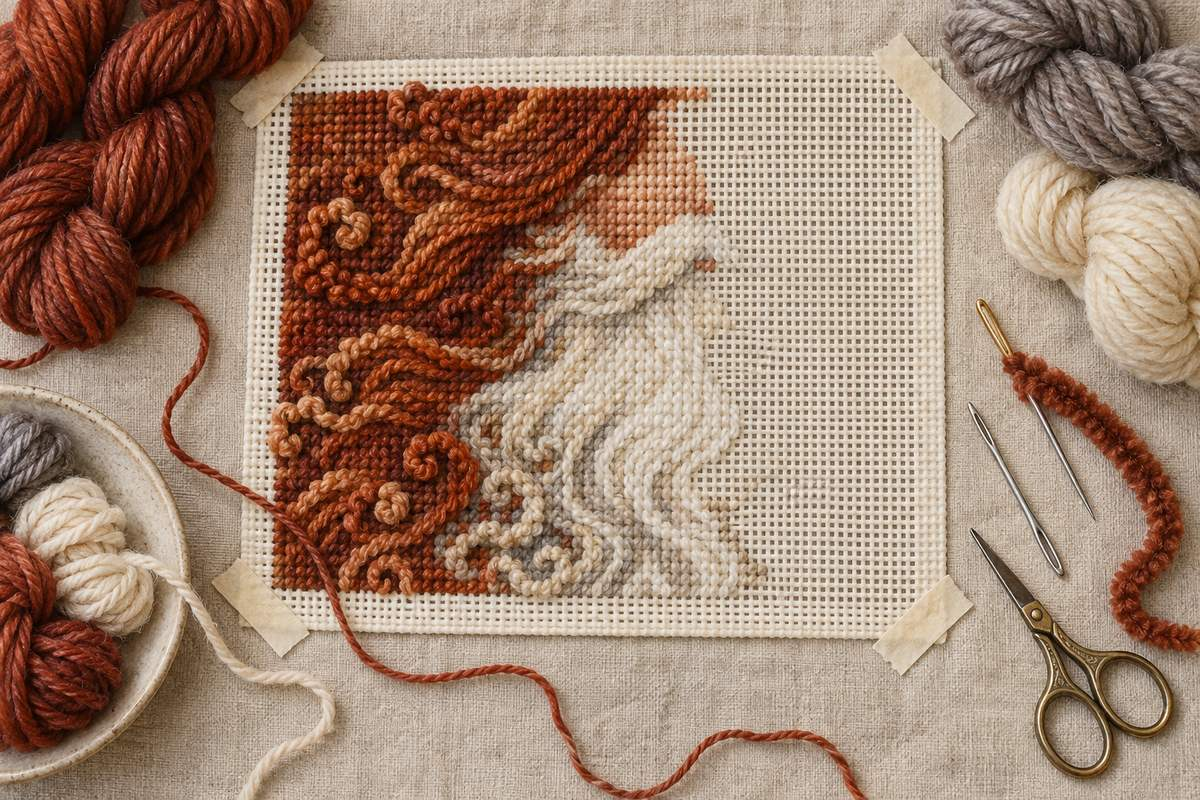
Needlepoint hair and beards look wrong when they are treated as one flat shape. Real hair has direction, overlap and mixed color; a beard can be crisp, curled or softly piled, but it still needs structure underneath. The best stitch depends on the texture you want the viewer to feel. This guide compares flat Gobelin, gathered stitches, French and bullion knots, and Turkey work so you can choose before you fill the shape. Last updated November 4, 2026.
Start here: Decide what kind of hair you are stitching before picking a stitch. Use slanted flat stitches for smooth hair, gathered or knotted stitches for curls, and Turkey work only where a true fuzzy pile belongs. Stitch the lowest layer first, then put mustaches and overlapping hair on top.
Read the shape first
Nuts about Needlepoint begins with analysis, not stitching. On a pirate canvas where hair, beard and mustache were painted as one block, the first job was to decide where one area stopped and the next began. A hat, cheek, lip or chin gives you boundaries the paint may not spell out. Mark those decisions before you thread a needle, especially when the same color covers several parts.
Look for direction next. Smooth hair usually moves in long curves, a beard breaks into shorter locks, and a mustache turns down or out from the lip. A stitch that ignores those directions makes the shape look pasted on. Even a simple stitch becomes convincing when its slant changes with the growth pattern.
Layer hair, beard and mustache
Layering is the difference between a face with hair and a brown shape attached to a face. Nuts about Needlepoint stitched the pirate's beard first, kept the area under the mustache flat, then added hair and the mustache over it. That order matters: overlapping parts should be stitched after the parts beneath them, just as they would sit on the face.
For a beard, start near the mouth and keep the upper structure smooth enough that later layers can sit on it. Serendipity Needleworks answers the common Santa question the same way: start up near the mouth. If you plan a raised edge, leave room for it rather than filling every canvas thread first. Pile spreads beyond its nominal footprint, and our Turkey work guide gives the seam allowances that raised stitches need.
Flat and smooth hair
For smooth hair, use the stitch direction to do the work. Nuts about Needlepoint used Gobelin in varied slants for short hair under a hat, Encroached Gobelin for the beard base, and layered downward-slanting Gobelin for the mustache. The result reads as hair because the stitches follow the form, not because the stitch itself is fancy.
Flat stitches are also the right choice when the face already has strong detail. A large curly or piled texture beside finely shaded skin can overwhelm it. If the canvas calls for sleek hair, braid or a short cropped edge, keep the surface low and use color changes for shine. Our Gobelin stitch guide covers straight, slanted and encroaching versions.
Curls and coils
Needlepoint-For-Fun recommends a gathered stitch for springy curls. Bring the needle up, pierce the working thread at three points about 1/8 to 1/4 inch apart, go down in an adjacent hole, and pull until the gathered thread forms a curl on top of the canvas. Use a sharp chenille needle because you are piercing the yarn, and choose a twisted thread; an untwisted single-ply thread will not curl as well.
French knots, French knots on stalks and bullion knots give a tighter, more sculptural curl. Serendipity Needleworks uses French knots for Santa beards and lists the pistil stitch, a French knot at the end of a straight stitch, as another option. The Wool and The Floss recommends bullion knots for Santa beards, palm fronds and hair. Its tutorial uses a bullion or milliner-style needle whose eye and shaft are the same width, making it possible to pull the needle through the wraps.
Knot scale matters. The Wool and The Floss notes that slimmer short bullion needles make smaller knots while wider needles make wider ones, and that a single ply can be coaxed into a curve and tacked in place. Use small knots for short curls and longer bullion knots for ringlets. If every knot is identical, the hair will look machined; vary length and direction within a deliberate rhythm.
Fluffy beards and pile
Turkey work creates a true pile. Floss Field describes it as thread loops tied to the canvas by small flat stitches, left as loops or cut into a soft pile. It lists beards, hair, fur, fringe, flower centers and rabbit tails as natural uses. For hair, the loops can remain looped for stylized curls. For a fluffy beard, fill the shape, cut every loop open, then trim gradually with sharp scissors.
Floss Field's numbers keep the pile under control: loops about 3/4 inch long leave room to trim down to a low 1/4-inch pile, removing only about 1/16 inch at a time and brushing often. Wool is the first-choice fiber because its crimp keeps loops and cut ends standing. Pearl cotton also stands up; soft silk goes limp. For a fuller tuft, thread several lengths together.
Pile should be the last surface in its area because it spreads over neighboring stitches. Floss Field recommends at least three tent stitches between pile and any seam. For a Santa ornament, that means the face, hat edge and nearby background should already be settled before the beard fluffs over them.
Choose thread for hair
Flat, solid thread is the usual reason stitched hair looks like a helmet. Nuts about Needlepoint recommends heathered, hand-dyed or tweeded wool when possible because hair is rarely one flat color. Its pirate example uses a heathered gray wool for the beard and mustache. For smooth hair, a gently variegated thread can supply highlights without forcing you to change colors every few stitches.
Match fiber to texture. Wool and pearl cotton hold loops and cut pile; silk and very soft threads collapse. Use one or two plies for knots that need definition, and several plies for a fuller bullion or tuft. If you are blending colors in the needle, keep the mixes subtle and repeat them across the head. Random highlights read as lint, not shine.
Where sources disagree
Are knots better than a gathered stitch for curls?Needlepoint-For-Fun favors the gathered stitch because it forms a springy curl directly from the working thread. Serendipity Needleworks reaches for French knots and French knots on stalks, while The Wool and The Floss favors bullion knots. Gathered stitches give loose loops, French knots give compact bumps, and bullion knots give elongated coils. The right answer is the curl shape, not a universal best stitch.
Should a beard be flat or fuzzy? Nuts about Needlepoint builds a convincing beard from layered flat Gobelin. Serendipity Needleworks offers counted stitches and surface knots, and Floss Field makes Turkey work the full-pile option. Flat is better for groomed hair and small faces; knots and pile work when the canvas calls for softness and the surrounding features can survive the bulk.
Should you cut Turkey work loops? Floss Field allows both. Loops left intact read as curls or fringe; cut loops can be trimmed into fur, hair or a fluffy beard. The deciding factor is control. Loops keep their original rhythm, while cut pile needs patient trimming and brushing to avoid a chopped edge.
FAQ
What stitch is best for needlepoint hair? Use slanted Gobelin or another flat stitch for smooth hair, a gathered stitch for loose curls, French or bullion knots for defined curls, and Turkey work for pile. Nuts about Needlepoint's core rule is to follow the painted growth direction.
What stitch is best for a Santa beard?Serendipity Needleworks recommends French knots, double brick, split encroaching Gobelin, criss-cross Hungarian and French knots on stalks. For a genuinely fluffy beard, Floss Field's Turkey work is the raised-pile option.
How do you make needlepoint curls?Needlepoint-For-Fun's gathered stitch pierces the working thread at three points, then pulls it into a curl on top of the canvas. A sharp chenille needle and twisted thread make the curl form cleanly.
What thread looks most like hair? Heathered, hand-dyed or tweeded wool is Nuts about Needlepoint's pick because real hair is rarely one flat color. Wool also holds Turkey work loops and trimmed pile better than soft silk.
Where do you start a beard? Start near the mouth, as Serendipity Needleworks advises, and keep the area under a mustache flat. Stitch lower layers before hair or mustache sections that overlap them.
Why does my Turkey work look messy? The loops may be uneven or the pile may need slower trimming. Floss Field recommends forming loops over a pencil, knitting needle or straw, cutting after the shape is full, and trimming about 1/16 inch at a time while brushing often.
Sources
- Nuts about Needlepoint - Needlepoint Hair and Beards (a needlepoint teaching blog, updated July 2021; shape analysis, layering, flat Gobelin and heathered thread)
- Floss Field - Turkey Work in Needlepoint (a needlework reference site; loop construction, trimming measurements, fiber choices and pile placement)
- The Wool and The Floss - How To: Bullion Knot for Needlepoint (a needlepoint shop tutorial, December 2024; bullion needles, wrap control and curved knots for hair and beards)
- Serendipity Needleworks - Stitches for Santa's Beard (a needlepoint teaching site, December 2020; French knots, counted alternatives, pistil stitches and where to start)
- Needlepoint-For-Fun - Stitch Curly Hair With a Needlepoint Gathered Stitch (a needlepoint technique blog, July 2011; gathered-stitch curls, chenille needles and twisted thread)