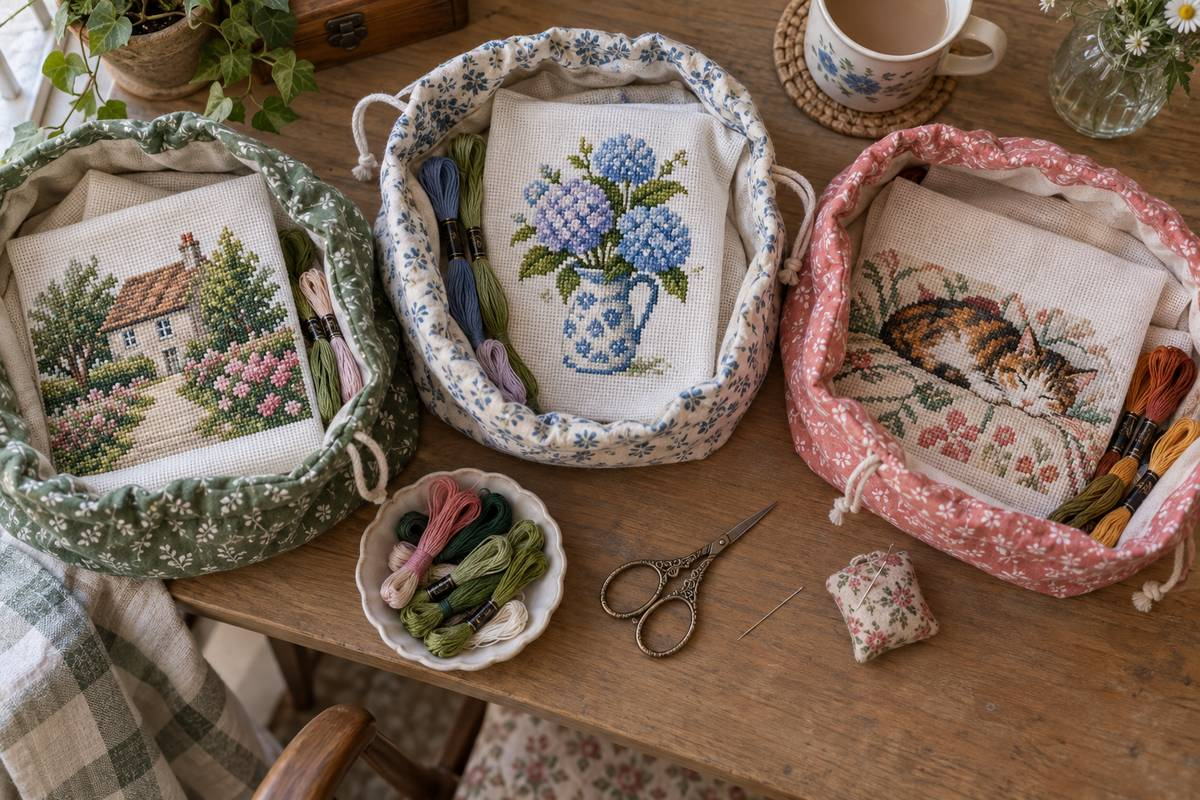
One project in the hoop, two kitted up in bags, and a drawer you would rather not open in company: that is a normal cross stitch life, not a failure. The problem is never the number of works in progress, it is losing track of them, which floss went with which chart, where you stopped, and why. This guide covers the one-bag-per-project setup, paper and digital tracking systems, rotation methods from dice to bingo, how to revive or release stalled projects, and storage that protects fabric, charts and thread. Last updated November 8, 2026.
Start here: Give every project its own bag holding the fabric, chart, floss, needle and scissors, so picking it up never requires a scavenger hunt. Then make a list: every WIP, its start date, a status (in rotation, resting, stalled, waiting on supplies, done) and a note on where you stopped. That ten minutes turns the drawer of guilt into a menu.
Why WIPs pile up, and why that is fine
Lost in Cross Stitch, stitching with seven projects on the go, frames it well: projects have different jobs. A big piece suits a long Sunday with an audiobook, something small and simple suits a tired weeknight, a seasonal ornament gets started in October, a stitch-along releases in parts and makes you wait. WIPs are what it looks like when stitching is part of your life, and there is no right number. Treasure State Quilting, a project bag seller, agrees: many stitchers intentionally keep a large sampler for evenings, a travel project, seasonal stitching and a gift with a deadline all in play at once.
The only real risk is practical: supplies drift apart, and a project you cannot pick up in thirty seconds slowly becomes a project you never pick up. Organization is the fix, and it is cheaper than the stash it protects. Caterpillar Cross Stitch, a UK kit seller, adds a money angle: a system you can see at a glance stops you buying a second skein or another metre of 14 count you already own.
One bag per project
This is the single change that makes multi-project stitching work. Caterpillar Cross Stitch's rule: keep each project self-contained, fabric, chart, that design's threads, a needle and small scissors in one bag or zip wallet, because the alternative (one central thread box borrowed between projects) is how you end up short of a color halfway through. Treasure State Quilting's suggested bag contents add a needle minder, highlighter or pencil, and thread conditioner if you use one, and recommends keeping leftover floss with the project until it is completely finished.
Hannah Hand Makes adds the fiddliest case: when two projects share a color, split the skein and bag a length with each project rather than letting one bag hold the only copy, and give each project its own scissors and needle minder if you have spares. Bag choice details that help: a clear vinyl front shows which project is inside without opening it, and a small project card can record the designer, fabric count, start date, stitch count and goals. Lost in Cross Stitch keeps WIPs visible rather than filed away, because out of sight is out of mind. A zippered bag also protects against dust, pet hair, lost needles and travel wrinkles. For a big piece living on a frame or Q-snap that no bag fits, Caterpillar suggests a shallow crate or lidded box so the whole thing lifts out in one go.
Tracking: paper, spreadsheets and apps
A tracker answers three questions at a glance: what do I have, where is it, and where was I up to. Lost in Cross Stitch gives each WIP a line with start date, status and a note on progress and blockers, so returning after three months takes minutes instead of an evening of detective work. Optional extras: a daily stitching log, and an annual tracker that colors a square per day stitched, one color per project, which reveals your real rotation across the year.
Sirithre tested the digital options against four criteria (portable, customizable, syncing across devices, free to start) and uses a different tool per material: Google Sheets for a thread inventory, Trello boards with photos for fabric, and Airtable as the current favorite for WIPs, because one base can flip between spreadsheet, kanban and gallery views and group projects by anything, including fabric count when you feel like 28 count tonight. Evernote earns a caveat: it embeds pattern PDFs beautifully, but the free plan syncs only two devices. For progress during stitching itself, Treasure State Quilting names Pattern Keeper, Markup R-XP and Cross Stitch Saga as the apps stitchers use to mark completed stitches and watch completion percentages grow.
Choosing what to stitch tonight
Whim is a legitimate system, with one override: a deadline wins. Lost in Cross Stitch stitches whatever looks most interesting each evening, except that a gift with a date attached is priority every night until done. The failure mode of whim is the night every choice feels equal and you scroll your phone instead; the fixes are games. Number every WIP and let a dice roll or random number picker choose, or go further: WIPGO, invented by Jessie Marie, builds a bingo board of projects for the year and stitches by monthly draws. At the structured end, monthly plans and simple goals work too: Treasure State Quilting lists 100 stitches a day, one page a week, or a percentage by month-end, plus stitch-alongs for external pacing.
Stalled projects and UFOs
Every stalled project has a reason, and naming it is the fix. Lost in Cross Stitch's own stalls come from mistakes that need frogging, confetti-heavy patches, and the shiny new start; her working rule is no new patterns while the drawer is full. The gentlest tool is vocabulary: relabel the project "resting" instead of failed, and let the dice skip it for a while. Our fixing mistakes guide handles the frogging side.
Treasure State Quilting recommends a deliberate UFO review every few months: open the drawer, and either rediscover something you are excited to finish or consciously release it. A project you release frees its bag, frame and leftover floss back into the stash, which is another reason to keep project kits self-contained.
Storing fabric, charts and floss
Caterpillar Cross Stitch's storage rules start with light: sunlight fades thread and yellows fabric over months, so everything lives in the dark. Fabric stores best rolled around a cardboard tube rather than folded, because creases in aida are hard to press out without flattening the weave; sort it by count first, then color, because count is what you search for when starting a project. Paper charts belong in ring binders grouped however you think, with one caution: do not leave charts in plastic sleeves for decades, because the ink can transfer to the plastic and the chart loses detail when you pull it out. Back up PDF patterns somewhere that is not your laptop, and keep a list so you never buy the same chart twice.
Thread storage is its own debate. Project bags with the shade number written on are the cheapest flexible system; bobbins in a compartment box are compact and scannable, but winding takes ages and tight winding creases thread over time (the drill trick, holding a bobbin in a slow-turning electric drill, saves your wrists); floss drops on a binder ring flip through fast and never crease. Whichever you pick, use it consistently, and per Caterpillar's first rule, do not buy a storage system until you know how you stitch. For floss organization depth, our floss organization guide compares every method.
Where sources disagree
Bobbins or bags for project floss? Bobbin boxes win on compactness and visibility; bags win on zero winding time and no creases. Caterpillar Cross Stitch presents both with their honest downsides, creased thread versus rummaging, and Treasure State Quilting's only rule is to pick one method per project and keep it together.
Paper or app for tracking? Sirithre's criteria favor syncing digital tools, and her Airtable setup is the most powerful option described anywhere in these sources. Lost in Cross Stitch's printable tracker works with a pen and a dice roll, no syncing required. Choose by what you will actually update: the best tracker is the one that survives contact with a Tuesday evening.
Plastic sleeves for charts? Sleeving charts in binders is common advice for protecting paper. Caterpillar Cross Stitch warns that over decades the ink can transfer onto the plastic and destroy detail. Sleeve the charts you handle weekly; store the keepers bare.
FAQ
How many cross stitch projects should I have on the go? There is no right number. Stitchers range from strict one-at-a-timers to rotations of a dozen. The workable test is organizational: if every project has its own bag and a line on your tracker, the number takes care of itself.
What is the best way to store cross stitch WIPs?One zippered project bag per WIP holding fabric, chart, that project's floss, needle, scissors and needle minder. Clear fronts show what is inside; large pieces on frames go in a shallow crate or lidded box. Keep everything out of direct sunlight.
What is a WIP and a UFO in cross stitch? A WIP is a work in progress, a project you have started and still intend to stitch. A UFO is an unfinished object, a WIP that has sat untouched so long it has effectively retired to a drawer. Review UFOs every few months: revive them or release them.
What apps do stitchers use to track projects?For marking stitches during a project, Pattern Keeper, Markup R-XP and Cross Stitch Saga are the popular choices. For inventory and WIP lists, stitchers use Google Sheets, Trello, Evernote and Airtable, plus printable planners if you prefer paper.
How do I get back into a project I abandoned?Read your tracker note on where you stopped, check the chart and floss are all in the bag, and stitch one small section, not a marathon session. If the reason you stalled is still there (a mistake to frog, a confetti patch), fix that first or the project will stall again.
Should I keep leftover floss with the project or file it back? Keep it with the project until it is completely finished, so mid-project top-ups match and nothing gets borrowed away. File it back into your main stash only after the finish.
Sources
- Lost in Cross Stitch - Too many cross stitch WIPs? (a stitcher's WIP management guide; status labels, the dice and WIPGO games, why WIPs pile up, and how stalls happen)
- Treasure State Quilting - How to organize multiple cross stitch projects (a project bag seller's guide; bag contents and clear fronts, project cards, tracking apps, goals and UFO reviews)
- Sirious Stitches - Inventory tracking: patterns, WIPs and materials (a stitcher's tool comparison; the four tracker criteria, and Google Sheets, Trello, Evernote and Airtable setups with their free-plan limits)
- Caterpillar Cross Stitch - Cross stitch storage ideas (a UK kit seller's storage guide; sunlight damage, rolling fabric, the plastic sleeve caution, and bobbins versus bags versus floss drops)
- Hannah Hand Makes - Organise your stash (a designer's podcast episode; one bag per project, splitting shared colors across projects, and duplicate tools per bag)