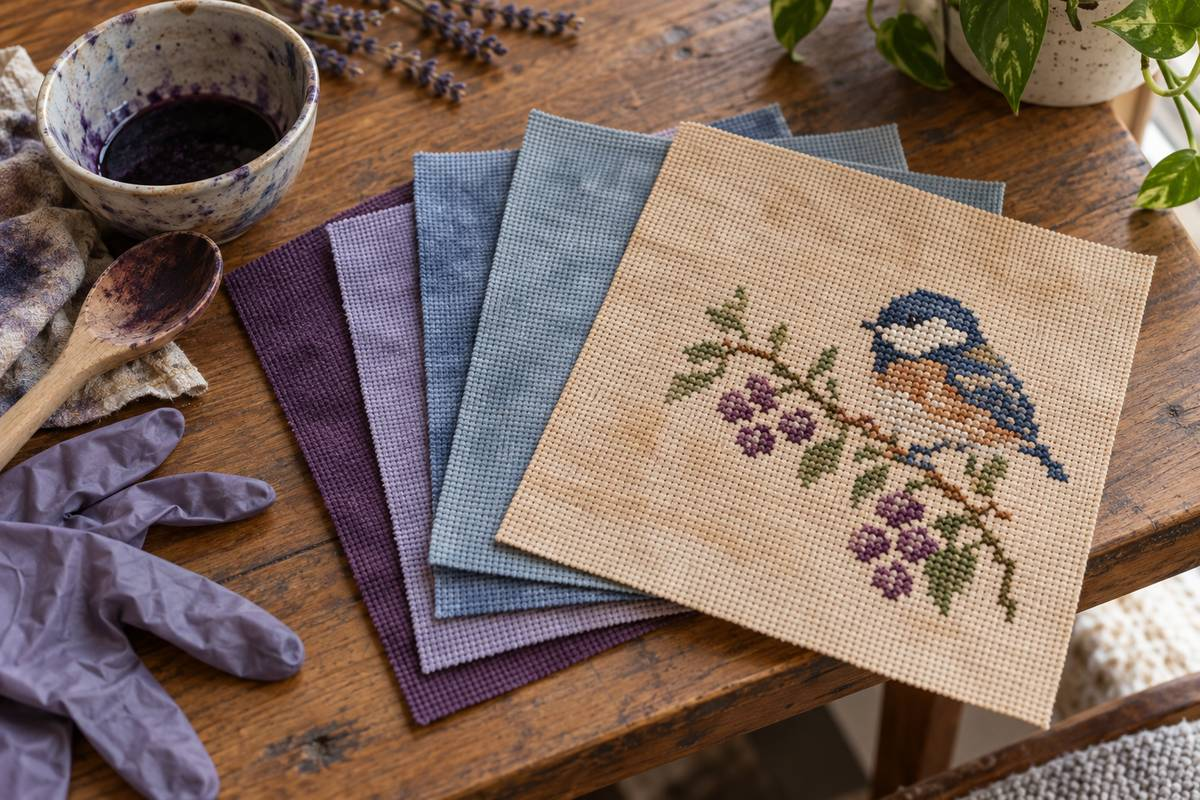
Shop aida comes in a narrow band of pale colors, and sometimes the pattern in your head needs a stormy blue sea, a deep Halloween purple or a parchment tone that makes a sampler look a century old. Dyeing your own cross stitch fabric is a bowl, hot water and an afternoon, and it works on the cotton aida and linen you already have. This guide covers which fabrics and dyes pair up, tea and coffee for an aged look, the standard dye bath, mottled and painted effects, and how to keep the color from shrinking, bleeding or fading later. Last updated November 8, 2026.
Start here: Dye before you stitch, on white or pale cotton or linen, with the edges zigzagged and the starch washed out. Wet the fabric, lower it into a hot dye bath with salt, stir for the first 10 minutes and soak 10 minutes to an hour, then fix, rinse until the water runs clear, dry flat and press. Judge the color only when dry, because wet fabric looks far darker.
Why stitchers dye fabric
Lord Libidan gives two reasons: color choice and color variation. Zweigart and DMC sell many counts but concentrate on pale shades, so a bright orange grass-green or true purple ground is hard to buy. Dyeing also gives organic, uneven color that no bolt fabric has: his example is a mermaid stitched on hand-dyed blues and greens that read as a moving sea. Floss Field adds the oldest reason of all, tea or coffee for the soft tan of antique linen on primitive samplers.
Dyeing is done before stitching, not after. Floss Field states it plainly: color the cloth, let it dry, then stitch. Victoria Sampler notes that some stitchers dye a completed piece for an antiqued look, but treats it as a risky exception that needs care to protect the threads, and Lord Libidan's own FAQ says never to dye a finished cross stitch. Plan the ground color first.
Fabric and dye choices
The fiber decides the dye. Victoria Sampler explains that linen (flax) and aida (almost always 100 percent cotton) are natural plant fibers that take dye readily, while many evenweaves blend in rayon or polyester that will not absorb standard cotton dye the same way. Floss Field sees the same thing from the results side: blended evenweave takes the same bath lighter and differently. Start with white or a pale color, because dye adds to whatever is already there; Lord Libidan warns that dye over colored aida will not bond the way you hope.
For cotton and linen, Victoria Sampler recommends a fiber-reactive dye such as Procion MX, which bonds chemically to plant fibers and resists fading and bleeding through later washes; she has also used Rit all-purpose dye on linen with success, and Rit (US) or Dylon (UK) are the names Lord Libidan gives as the common beginner options. For synthetic-blend evenweave you need a disperse dye such as iDye Poly, set with heat, and she advises testing a small piece first because heat can shrink or distort the cloth. Natural dyes (tea, coffee, onion skins, walnut shells) give softer antique tones but are less predictable and can fade over years of sunlight.
Prep matters as much as the dye. New aida is stiffened with starch that resists color, so wash it out in warm soapy water first, as Floss Field and Canafete both instruct. Finish the raw edges with a zigzag or overlock stitch before the bath: Canafete recommends a sewn edge because it survives the dye bath and the whole stitching project, and explicitly does not recommend tape. Wet the fabric before it goes in the dye, or the color absorbs unevenly.
Tea and coffee dyeing
Tea and coffee are the simplest entry point. Floss Field's method: brew far stronger than you would drink, six to nine tea bags in a pot or a pot of strong coffee, with black tea giving the surest brown. Wet the cloth, squeeze it out, and soak it spread out and submerged for even color, or crumpled for a mottled one. Wait 30 minutes to an hour or more, checking occasionally, and judge it darker than your target, because wet cloth looks darker than it will dry and rinsing lifts more color. Rinse cool until clear, dry flat on an old towel, and press while slightly damp.
One honest caution from Floss Field: tea and coffee are acidic, and museums keep acids away from textiles because acid yellows and weakens cloth over time. A tea-dyed piece will still last many years, but it will age sooner than unstained cloth, so weigh that for an heirloom. Herbal teas give other tints but fade or wash out more readily than black tea.
The fabric dye bath, step by step
Every dye packet leads, and the makers' instructions come first; the shared process across sources looks like this. Canafete, a pattern seller that ships dye recipes with some of its charts, uses Rit liquid in a bucket with 2 litres of water at about 60 degrees C (140 F), plus salt and a drop of dish detergent, and tests the color by dipping a paper towel square, which absorbs the full shade in seconds. Lord Libidan adds about half a cup of salt per 8 litres of water, because salt helps the cotton bond to the dye and bleed less. Use a bowl or bucket you will never use for food again, wear gloves, and cover the table; Floss Field adds that one dye seller asks for a dust mask while handling powdered dye.
Add the fabric wet. For an even color, use plenty of water and keep the cloth moving, especially for the first 10 minutes, because creases collect dye along fold lines. Leave it 10 minutes to an hour depending on the depth you want, lifting it out to check; Lord Libidan once pulled a piece after 30 seconds at the perfect shade. Then fix the color: some dyes fix in the bath, others want a fixative straight after. Canafete moves the fabric into a fresh hot bath with Rit ColorStay fixative for 20 minutes before any rinse, and Victoria Sampler suggests Retayne or a similar fixative as insurance, especially with all-purpose dyes. Rinse cool until the water runs completely clear, wash warm with a little mild detergent, and dry flat; never wring the cloth, roll it in a towel instead. Press when dry to restore the weave.
Mottled, ice and painted effects
Even color is only one option. Victoria Sampler describes sprinkling powdered dye directly onto damp fabric for watercolor and marbled effects, and scrunching or twisting the cloth instead of stirring for mottling. Rabbit Girl Crafts surveyed the wider menu: ice or snow dyeing, where fiber reactive dye is scattered over ice on the fabric and separates into organic blooms as it melts; shaving cream marbling, where dye is swirled through a layer of shaving cream and the fabric pressed into it; and painting aida directly with thinned paint or watercolor for fully placed color. Partial dyeing works too: Lord Libidan notes that using only enough water to cover half the fabric gives a dipped, two-tone effect.
Shrinkage, bleeding and aftercare
Hot water shrinks cotton. Canafete budgets roughly 5 percent, about one thread count per inch on good quality 100 percent cotton, so a 9 by 12 inch design on 18 count can finish closer to 8.5 by 11.25. Their answer is to cut the fabric with an extra inch on each side before dyeing, or to dye fabric one count lower than the pattern specifies so it shrinks back to the intended count. Dye the full piece for the project, with its finishing margin, in one bath.
Color that was not rinsed out is the main long-term risk: it can come off on your thread as you stitch or run when the finished piece is washed. Rinse until clear, fix the dye, and when you later wash the finished piece use cold water and do not soak it, as Floss Field advises; our wash and care guide covers that final wash. Victoria Sampler notes that fiber-reactive and disperse dyes form chemical bonds with the cloth and will not rub off or fade in normal care, while natural dyes mellow in bright light, so display naturally dyed work out of direct sun. Lord Libidan adds that machine drying tends to lighten the color a little, and suggests steaming rather than washing a finished piece on hand-dyed fabric.
Where sources disagree
Which dye for cotton? Victoria Sampler recommends fiber-reactive dyes like Procion MX as the best long-term choice for cotton and linen, with all-purpose Rit or Dylon as acceptable. Lord Libidan presents Rit and Dylon as the standard beginner option without ranking dye chemistry. The practical difference shows up at the first wash of a finished piece: fiber-reactive bonds resist bleeding best, while all-purpose dye benefits from a fixative step.
Wash hand-dyed fabric before stitching, or only rinse until clear? Lord Libidan strongly suggests washing hand-dyed aida before use in case color bleeds out. Floss Field and Canafete rely on rinsing until the water runs clear, then a normal warm wash with mild detergent as part of the process itself. Both end at the same place; the difference is whether you treat the post-dye wash as optional or built in.
Can you dye after stitching? Victoria Sampler mentions stitchers who dye a finished piece for an antiqued look, with caution to protect the threads. Lord Libidan's FAQ says not to dye a completed cross stitch. If you want an aged ground, dyeing the blank fabric first is the route every source treats as safe.
FAQ
Can you dye aida fabric for cross stitch? Yes. Aida is almost always 100 percent cotton and takes fabric dye well. Start with white aida, wash out the starch, zigzag the edges, and dye it before you stitch, rinsing until the water runs clear.
How do you dye cross stitch fabric with tea or coffee? Brew six to nine tea bags or a pot of strong coffee, wet the fabric, and soak it 30 minutes to an hour or more, judging the shade darker than you want because it lightens as it dries and rinses. Rinse cool until clear and dry flat. Black tea gives the most reliable brown; herbal tints fade faster.
Will hand-dyed fabric bleed onto my floss? It can if loose dye is left in the cloth. Rinse until the water runs completely clear and use a fixative such as Rit ColorStay or Retayne for insurance, especially with all-purpose dyes. Fiber-reactive dyes bond to the cotton and are the most bleed-resistant option.
Does dyeing shrink cross stitch fabric? Yes, hot water shrinks cotton by roughly 5 percent on good quality fabric, about one count per inch. Cut an extra inch on each side before dyeing, or dye fabric one count lower than the pattern calls for so it shrinks to size.
Can you dye evenweave or linen? Linen dyes beautifully with the same fiber-reactive dyes as cotton. Evenweave depends on its fiber: all-cotton or all-linen evenweave dyes like aida, but blends with rayon or polyester take cotton dye lighter and unevenly, and need a disperse dye set with heat instead.
Is dyeing fabric safe to do in the kitchen?Use gloves, cover the surface, and retire any bowl, bucket or spoon from food use once it has held dye, because dye ingredients are not food-safe. One dye maker also asks for a dust mask with powdered dye. Disposal rules vary by country, so check yours before pouring a bath down the drain.
Sources
- Lord Libidan - How to hand dye aida (and why you should try it) (a cross stitch designer's tutorial; why dye, the salt bath and stir times, Rit and Dylon, wet-versus-dry color, machine drying lightening, and care of hand-dyed fabric)
- Floss Field - Dyeing cross stitch fabric (a cross stitch reference site's guide; dye before stitching, fiber behavior, tea and coffee method and its acid caution, the shared dye-maker steps and safety kit)
- Victoria Sampler - Dyeing your fabrics for stitching (a needlework designer's article; fiber-reactive versus disperse dye choices, soda ash and fixatives, troubleshooting blotches, and how long each dye type lasts)
- Canafete - Dyeing fabric (a cross stitch pattern seller's process page; the Rit liquid bath with fixative quantities, the paper towel color test, the 5 percent shrinkage budget and sewn-edge advice)
- Rabbit Girl Crafts - Tutorials for dyeing your own cross stitch fabric (a stitcher's curated survey; ice and snow dyeing, shaving cream marbling, painting aida, and tea and coffee variations)