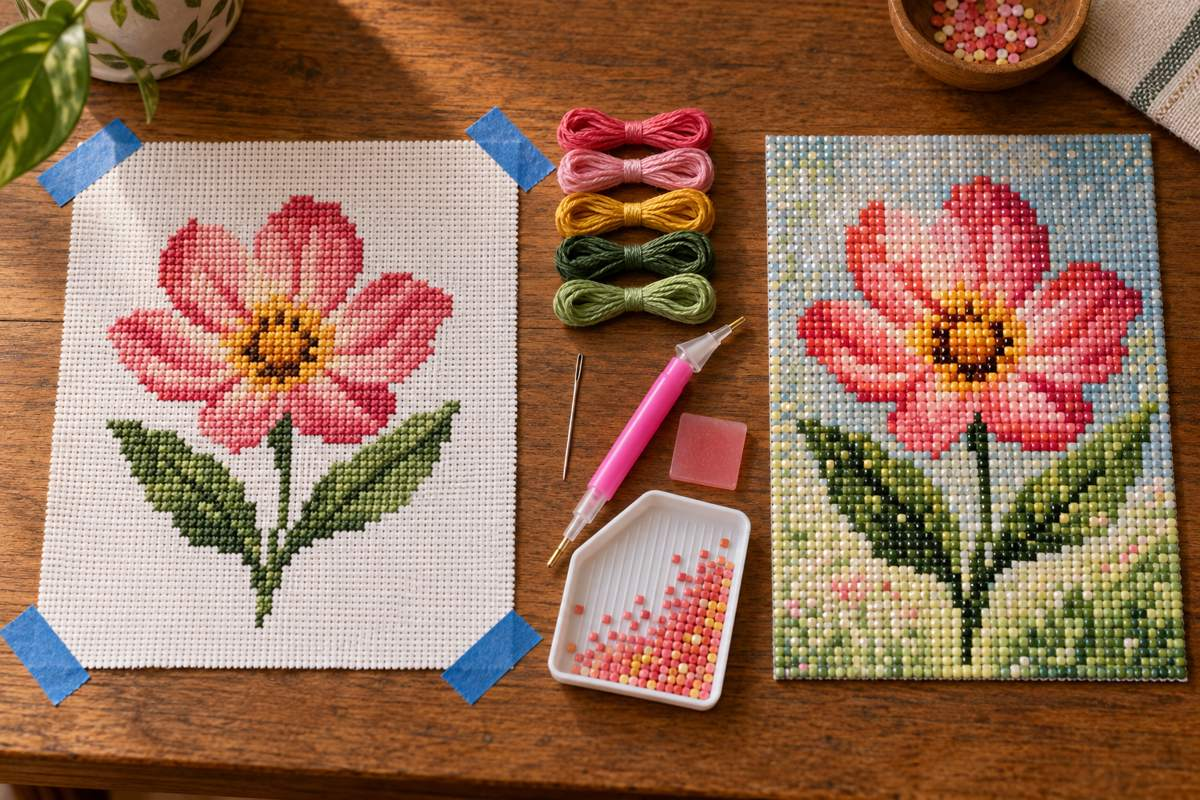
Diamond painting is often shelved next to cross stitch and marketed with borrowed words like "5D diamond embroidery," but it is a different craft: no needle, no thread, just resin drills pressed onto a sticky printed canvas. The two share a gridded chart, which is why patterns and even DMC color numbers can cross over. This guide compares them on technique, difficulty, speed, cost, detail and finish, so you can pick the one that suits you, or convert work between them. Last updated November 7, 2026.
Start here: Choose diamond painting if you want a fast, no-skill-start, sparkly mosaic: kits often include the basic tools, small canvases can finish faster than detailed stitching, and there is no needle to thread. Choose cross stitch if you want finer detail, a traditional textile finish, cheaper ongoing projects and pieces that last generations. Cross stitch charts convert to diamond paintings square for square, but only for full crosses.
What diamond painting is
A diamond painting starts as a canvas printed with a grid of symbols, the printed side covered in glue under a clear film. For each symbol you pick up a small resin drill of the matching color with a pen tipped in wax and press it onto its square, peeling the film back a little at a time so the glue stays clean. Floss Field describes the drills as flat underneath and faceted on top so they sparkle; round drills leave tiny gaps, while square drills sit edge to edge like tiles.
Two naming confusions are worth clearing up. "5D" (or 3D) is a selling word for how the drills are cut and how much they sparkle, not a kind of stitching; Thread Bare notes the terms are now used almost interchangeably. And "diamond embroidery" is not a separate craft at all: Drill n Dazzle confirms it is simply another name some sellers use for the same diamond painting kit, the way "gem art" is. Kit makers themselves describe the craft as a cross between cross stitch and painting by numbers, because it follows a symbol chart the way cross stitch does, but with no needle and no thread.
The big differences
| Cross stitch | Diamond painting | |
|---|---|---|
| Materials | Fabric, needle, floss | Adhesive canvas, resin drills, pen, wax, tray |
| Technique | Hand-sewn X-shaped stitches | Drills pressed onto matching symbols |
| Skill to start | Needle handling, chart reading, tension | Symbol matching and accurate drill placement |
| Finished look | Soft, matte, textile | Glossy, sparkling mosaic |
| Speed | Slower, one stitch at a time | Faster, one placement at a time |
Drill n Dazzle's quick answer captures the shape of the comparison: diamond painting is generally faster and easier to learn, while cross stitch allows finer detail and a more traditional textile finish. Made with Diamonds, a diamond painting seller, agrees that diamond painting is easier to pick up because the drills are pre-cut, pre-sorted and matched to a printed canvas, where cross stitch asks for practice to keep a pattern neat and even.
The feel of the work differs too. PaintbyDot describes diamond painting as a meditative, low-focus rhythm that lets the mind disengage, and cross stitch as focused, mindful concentration that rewards patience. These are the seller's descriptions of the experience, not clinical evidence of a mental health benefit. Your own comfort with counting, sorting and repetition is more useful.
Detail and resolution
This is the technical difference most comparisons skip, and it genuinely decides detailed projects. Diamond painting has a resolution set by the drill size. A 2.5 mm square drill gives four drills per centimeter, or about 10 per inch, much coarser than 14 count cross stitch. Some comparisons confuse drill width with drills per centimeter; check the kit's actual grid, rather than copying that unit error. Cross stitch scales with your fabric: 14, 16 or 18 count packs progressively more stitches into the same space, so high-count cross stitch holds fine detail a diamond painting of the same physical size cannot match. Detailed diamond paintings compensate by being printed bigger.
Thread Bare adds a buying warning that applies to both crafts: never judge a kit by the original artwork. Ask to see a mockup of how the image looks reduced to the pattern's actual size and color count, because the fixed drill grid turns subtle shading into large flat blocks faster than stitchers expect.
Cost, time and portability
Time. PaintbyDot's estimates: a standard 40 x 50 cm full-drill diamond painting takes about 20 to 30 hours, and small canvases under 30 x 40 cm finish in 4 to 10 hours, a weekend project. A comparable detailed counted cross stitch runs to weeks or months of regular sessions. Cross stitchers who try diamond painting notice first how fast progress feels, because placing a drill takes far less time than completing a stitch, as Drill n Dazzle observes.
Cost. Entry kits are similarly priced, but the shapes differ. Diamond painting kits are all-inclusive, typically $15 to $60 and up, with premium brands charging more for better adhesive, clearer symbols and better drills. Cross stitch starter kits run about $10 to $30, and once you own a thread collection, new projects cost little more than fabric and a pattern, with individual DMC skeins around $0.50 to $1.50. These are PaintbyDot's published estimates, not live shop quotes. Specialty threads, licensed art and elaborate finishing can change the cost for either craft.
Portability and accessibility. Cross stitch packs into a small bag: hoop, needle, floss. Diamond painting needs its canvas plus a tray of sorted drills, so a storage case helps. On the other hand, diamond painting has no sharp needle and relies on matching printed symbols rather than judging thread color by eye, which Drill n Dazzle flags as easier for children under supervision and for colorblind crafters.
Longevity. A properly stored cross stitch can last generations. PaintbyDot says diamond painting adhesive can release drills over time. It recommends sealing and framing, but treat lifespan estimates from a seller as estimates, not guarantees. Check the kit maker's care instructions before adding a sealant.
Using one chart for both crafts
The two crafts share the chart: a grid where every square has one symbol and every symbol stands for one color. Floss Field confirms a cross stitch chart converts to diamond painting square for square: a chart 100 squares wide is 100 drills wide. Three things change. Size: most drills are about 2.5 to 2.8 mm across while a stitch on 14 count Aida is about 1.8 mm, so a 100-square design that stitches to about 7 1/8 inches (18.1 cm) becomes roughly 10 to 11 inches (25 to 28 cm) in drills. Colors: many makers label drills with DMC floss numbers, so a cross stitch key often points straight to drill colors. And anything that is not a whole square: backstitch lines, quarter and three-quarter stitches and French knots have no drill equivalent, so full-coverage charts in whole crosses convert most cleanly. Our fractional stitches guide shows what you would be giving up.
Thread Bare's conversion article warns that some drill suppliers stock only the traditional 447 DMC range and may not have the later 01 to 35 colors. That is a supplier check, not a claim that all current drill ranges stop at 447. And if you work from a chart on a blank grid canvas rather than a pre-printed one, choose square drills: they snap into alignment and give solid coverage, while round drills leave gaps and are harder to line up without a printed guide.
The conversion runs backward too: a diamond painting canvas is already a chart of colored squares, so you can stitch one cross per drill. Count the squares each way and divide by your fabric count for the stitched size, as with any pattern. And if you want to turn your own image into a chart for either craft, our photo to pattern guide covers the conversion decisions.
Where sources disagree
Which looks better? There is no objective winner on appearance. PaintbyDot and Made with Diamonds describe diamond painting's sparkle as instant visual impact that reads as bold wall art, and cross stitch's stitched texture as warm, traditional and handcrafted. Thread Bare's comparison of the same image describes the diamond version as brighter and more solid, the stitched version as more delicate. Its article also notes that the diamond version was recolored more vividly, so the comparison is not a controlled test. It is taste, not quality.
Is diamond painting really easier? The comparison sources generally say yes for starting out, but they split on what that means. Drill n Dazzle frames cross stitch experience as not transferring at all, a fresh skill. Thread Bare treats the crafts as close cousins sharing charts and colors. Both are true: the chart logic transfers, the hand skills do not.
Are the "D" labels meaningful? Thread Bare describes 3D and 5D as labels for faceting that are often used interchangeably, while Floss Field calls 5D a selling term rather than a stitch type. Buy on drill shape, symbol clarity and adhesive quality, not the D count.
FAQ
Is diamond painting the same as cross stitch? No. Cross stitch sews X-shaped stitches in thread on woven fabric; diamond painting presses faceted resin drills onto a sticky printed canvas with a wax-tipped pen. They share only the gridded symbol chart. "Diamond embroidery" and "5D diamond painting" are marketing names for diamond painting, not kinds of cross stitch.
Which is easier for beginners? Diamond painting. There is no needle to thread, no tension to learn and no chart to count: you match symbols and press drills. Cross stitch has a steeper start but offers finer detail and a wider range of techniques.
Which is faster? Diamond painting, by a wide margin. A 40 x 50 cm canvas takes roughly 20 to 30 hours; a comparably detailed cross stitch runs to weeks or months.
Can I use a cross stitch pattern for diamond painting? Yes, square for square, if the design uses only whole cross stitches. Backstitch, fractional stitches and French knots do not convert. Expect the diamond version to come out about 40 to 55 percent larger than the same chart on 14 count Aida, and check that your drill supplier has every color in the key.
Do diamond painting drills use DMC numbers? Often, yes: many makers label drills with DMC floss numbers, so a cross stitch key can point straight to drill colors. Some brands use their own numbering with a conversion chart.
Which lasts longer? Cross stitch. A properly stored stitched piece can last generations; diamond paintings last for years but drills can loosen over time unless the piece is sealed and framed.
Sources
- Floss Field - Diamond painting vs cross stitch: what is the difference? (a cross stitch tools and guides site; what diamond painting is, the 5D label, chart conversion with drill sizing and DMC numbering)
- Drill n Dazzle - Diamond Painting vs Cross Stitch: Compared (a diamond painting seller's comparison; side-by-side table, fixed resolution, accessibility, and what cross stitchers notice first)
- Thread Bare - Cross-Stitching to Diamond Painting (a pattern-charting app's guide; the 447 DMC drill range, round vs square drills, canvas types and the mockup warning)
- PaintbyDot - Diamond Painting vs. Cross Stitch: The Ultimate Guide (a diamond painting seller's comparison; time and kit cost estimates, portability, longevity and therapeutic differences)
- Made with Diamonds - The difference between diamond painting and cross-stitching (a diamond painting seller's explainer; technique, difficulty and the look of each finished piece)