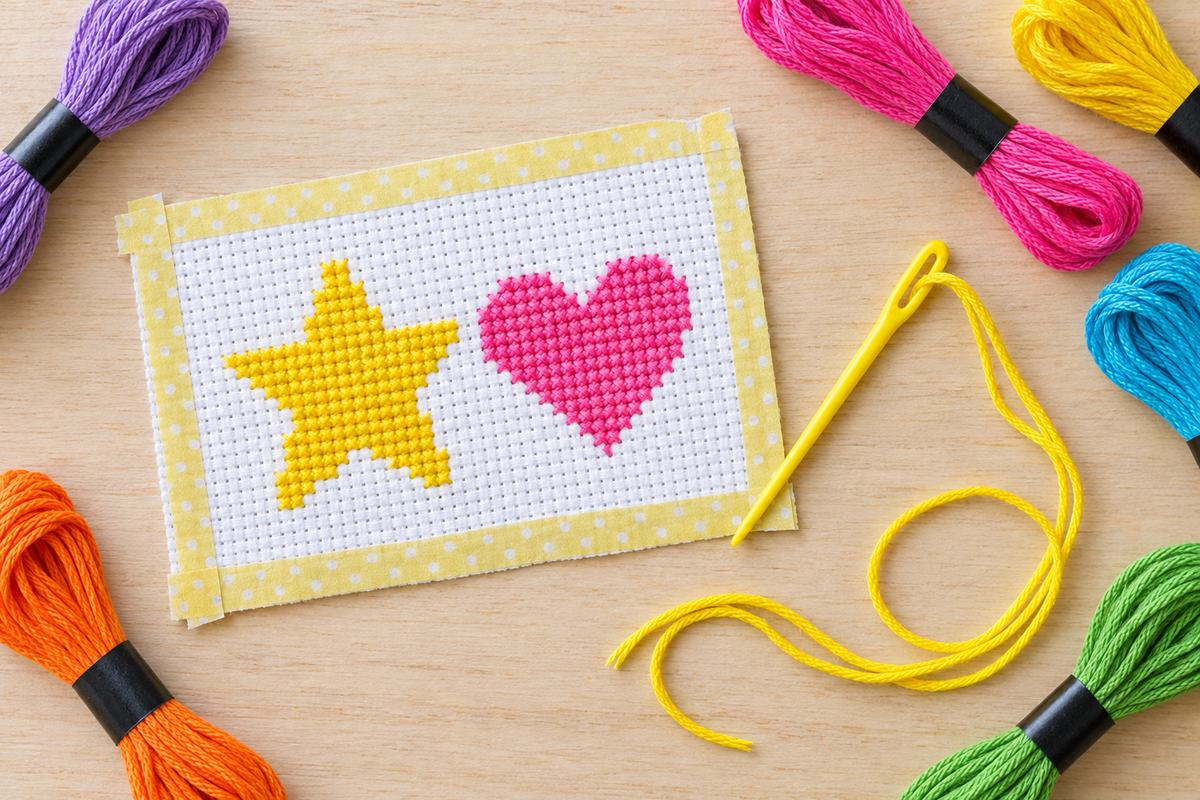
Cross stitch is one of the easiest crafts to hand down to a child: one stitch, a blunt needle, and fabric with holes that show exactly where the needle goes. The difference between a child who stitches for years and one who quits in an afternoon is almost never talent; it is the setup. This guide covers the right age to start, the materials that suit small hands, how to run a first lesson, and how to keep the hobby theirs. Last updated November 14, 2026.
Start here: Big squares, a blunt needle with a large eye, a short thread and a tiny design. Set everything up before the child sits down, teach one stitch, and stop while it is still fun. The goal of the first lesson is not a finished piece; it is a child who wants a second lesson.
What age to start
The honest answer is that the guides do not agree on a number, and Floss Field, a cross stitch reference site, says so directly: it depends on the child's hands, patience and interest more than on a birthday. The Stitchery Corner, a stitching guide site, puts the typical window at six to eight years old, when most children have the fine motor control for a pincer grip, pushing a needle through a hole, and counting squares. Stitching Jules Design says seven or eight is typical, and World of Cross Stitching, a UK magazine, notes children usually show interest around six or seven.
The Stitchery Corner offers a practical readiness test: if a child can write their own name legibly, they probably have the motor control, and a single X on 11-count Aida with a large blunt needle settles the question in five minutes. Floss Field adds the gentle fallback: a child who is not ready for cloth can practice the up-and-down motion on plastic canvas with yarn, and a child who is not interested this year may be next year.
The right materials for small hands
Every source agrees the standard adult setup is wrong for a child. Scale everything up and simplify.
- Fabric with big squares. World of Cross Stitching recommends low-count fabrics such as 6-count Binca or plastic canvas, where the holes are impossible to miss. Floss Field notes advice differs: some guides start children on 6 or 8 count Aida, others say many children manage ordinary 14 count, and plastic canvas is a third choice that needs no hoop because it is stiff.
- A blunt needle with a large eye. A tapestry needle is blunt already, which makes it safer than a sewing needle and easier to thread. For very young children, plastic needles exist.
- A short thread. Floss Field's rule is about 18 inches (45 cm); a longer thread tangles, and tangles end lessons.
- A hoop for cloth. It holds the fabric flat so small hands can aim.
- A tiny design. Floss Field's example: a design 20 stitches square comes to about 2.5 inches on 8 count, and is quick enough to finish before attention runs out. World of Cross Stitching's free kids' patterns use ten colors or fewer on 11-count fabric for the same reason.
For thread, World of Cross Stitching passes on a useful tip: on large-count fabrics like Binca, stitch with three strands rather than two so the bright colors cover the bigger squares fully.
A first lesson that works
Floss Field lays out a first lesson step by step, and the structure is worth following closely.
1. Set up before the child sits down: fabric in the hoop, thread cut, needle threaded, first end fastened. Starting and ending thread is the part children need help with at first.
2. Let them play first. Up through one hole, down through another, anywhere they like, just to feel the needle going in and out.
3. Show one cross, slowly: up at the bottom left of a square, down at the top right, up at the bottom right, down at the top left.
4. Hand it over. The child makes the next cross beside yours, then a row of three.
5. Check one thing only: that the second leg of every cross leans the same way. Leave everything else.
6. Stop early, while it is still fun, and let them show somebody what they made.
Bring a tiny chart to the second session: each square with a symbol is one cross, each symbol is one color. Our guide to reading a pattern covers charts, and cross stitch for beginners covers the stitch itself for an older child or a parent learning alongside.
Growing with the craft
The Stitchery Corner maps the later stages. Ages six to eight are the oversized phase: 11-count Aida, a size 22 or 24 tapestry needle, a pattern with fewer than twenty stitches in a single color, and sessions of about twenty minutes. By nine to eleven, most children can handle standard 14-count Aida and a simple multi-color chart, learn to thread their own needle (a needle threader makes this independent), and manage two or three colors in a session.
Twelve and up is when the craft can become truly theirs, and the advice flips: frame projects around the teenager's own interests, not traditional subjects. A favorite game character as pixel art, an album cover, a quote in a font they chose. Our pixel art to cross stitch guide and alphabet maker are made for exactly that. At that age, a video tutorial or a pattern they picked themselves beats instruction from a parent.
Safety stays simple: Stitching Jules Design says supervise younger children whenever needles and scissors are out, and The Stitchery Corner puts pointed embroidery scissors at around eight or nine with supervision, with blunt-tipped scissors or ring-style thread snips before that.
Keeping it their hobby
The Stitchery Corner's observation is blunt: children who stick with cross stitch are almost always the ones whose adults framed it correctly from the start. What works is letting the child choose the pattern from a pre-selected range, celebrating small progress instead of pushing for completion, stitching alongside them rather than watching over them, and keeping a kit that belongs only to the child. What fails is making it homework, setting deadlines, comparing their work to yours, or choosing the subject yourself.
World of Cross Stitching adds the motivation angle: small finished things, like a stitched card to give to someone, deliver the sense of achievement that brings a child back. And DMC's own suggestion to the magazine is a lovely next step once the basics land: let children color on graph paper and design their own patterns. Our graph paper guide and free pattern maker guide cover both ends of that idea.
Where sources disagree
The starting age. The Stitchery Corner says most children are ready between six and eight, Stitching Jules Design says seven or eight is typical, and World of Cross Stitching says interest usually appears at six or seven but kids of any age can start learning. Floss Field refuses to give a number at all. Read the child, not the calendar: the name-writing test and one trial X tell you more than any age chart.
Which fabric count. World of Cross Stitching starts children on 6-count Binca or plastic canvas. Floss Field reports that some guides say 6 or 8 count Aida while others say many children manage 14 count fine. Bigger holes are strictly easier; if frustration appears, scale the fabric up before scaling the ambition down.
Stamped or counted first. The Stitchery Corner suggests a small stamped kit for ages nine and up to remove the counting burden. Floss Field offers the same option but treats charts as a natural second step. For a first lesson, both agree: no chart at all, just the stitch.
FAQ
What is the best age to teach a child cross stitch? Most guides land on six to eight, when fine motor control is usually there. The better test: if they can write their name legibly and can make one X without real frustration, they are ready.
What supplies do I need for a child's first cross stitch? Low-count fabric (6 to 11 count Aida, Binca or plastic canvas), a large blunt tapestry needle, thread cut to about 18 inches, a hoop for cloth, and a tiny design.
Is cross stitch safe for kids? With supervision, yes. Tapestry needles are blunt by design, plastic needles exist for the youngest, and blunt-tipped scissors or thread snips cover cutting until about age eight or nine.
How long should a stitching session be? Short. The Stitchery Corner suggests about twenty minutes for a six-year-old, and every source says to stop while it is still fun rather than push to finish a section.
What is a good first project? A single-color design under about 30 stitches: a star, a heart, an initial. Stitched cards and small motifs that can be gifted give children the finished-thing payoff fastest.
Sources
This guide draws on the following sources. Where their advice differs, it says so above rather than blending them.
- Floss Field, cross stitch reference site: How to teach a child to cross stitch, flossfield.com. Source for the no-fixed-age position, the materials list, the step-by-step first lesson and the plastic canvas fallback.
- The Stitchery Corner, stitching guide site: How to Teach Your Child to Cross Stitch: A Complete Age-by-Age Guide, thestitcherycorner.com. Source for the age-by-age stages, the name-writing readiness test, session lengths, the scissor guidance and the keeping-it-theirs advice.
- World of Cross Stitching, UK cross stitch magazine: Cross stitch for kids: patterns, kits and tips, worldofcrossstitching.com. Source for the Binca and plastic canvas recommendation, the three-strand tip, the ten-colors-or-fewer pattern standard, stitched-card motivation and DMC's design-your-own suggestion.
- Stitching Jules Design, cross stitch designer: 9 Tips For Teaching Kids How To Cross-Stitch, stitchingjulesdesign.com. Source for the age guideline, the supervision and safety-materials advice, and the short-sessions and let-them-choose tips.