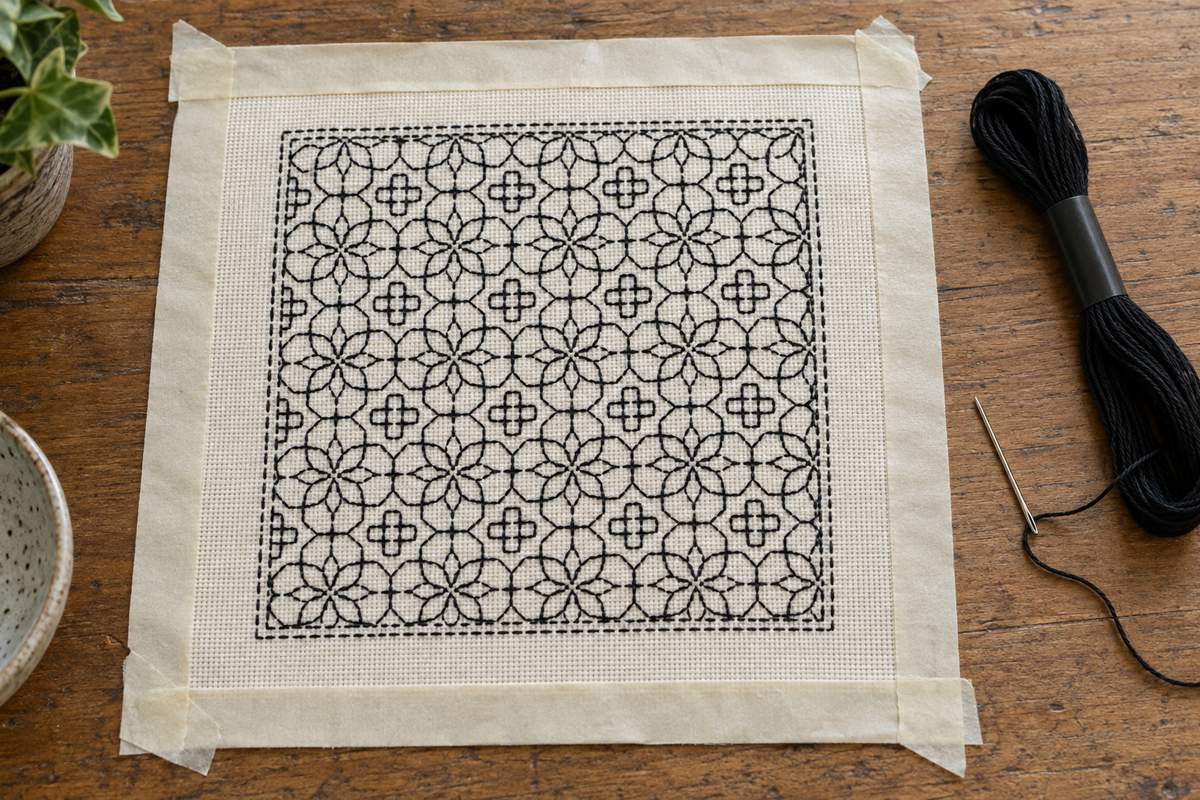
Blackwork is the counted-thread technique that paints with geometry: repeated straight stitches build crisp geometric fills, and the shading comes from how tightly those stitches sit together, not from changing thread color. If you can count a cross stitch chart, you already have the core skill. This guide covers what blackwork is and where it came from, the fabric and thread to start with, the double running (Holbein) stitch, how to follow a fill pattern without getting lost, density-based shading, and how neat the back really needs to be. Last updated November 8, 2026.
Start here: Use an evenweave fabric (14 count aida is fine for a first piece), one skein of stranded cotton and a blunt tapestry needle. Work the design outline first, then fill it with double running stitch: travel along the charted route working every other stitch, then come back along the same path filling the gaps. Count each fill repeat from the edge it shares with the last one, and travel thread under worked stitches, never across open fabric.
What blackwork is
Blackwork is a counted thread embroidery technique that builds patterns, texture and shading from repeated geometric stitches on evenweave fabric, as Needlework Tips and Techniques, a teaching site by designer Carol Leather, defines it. Traditionally it was worked in black thread on white linen, which is where the name comes from, but modern blackwork uses color, metallics and varied thread weights freely. SewGuide adds the historical texture: it became fashionable in England after Catherine of Aragon brought the style from Spain, which is why old sources call it Spanish work, and Tudor portraits by Hans Holbein show it dense on collars and sleeves. It earned the nickname poor man's lace because the geometric fills imitated expensive lace at a fraction of the cost. The Royal School of Needlework's StitchBank pushes the technique far further back: double running stitch appears on a medieval fragment excavated in Egypt, and it filled Ottoman, Moroccan and Syrian embroidery for centuries, so blackwork is one stop on a much longer road.
The stitch at its heart is the double running stitch, also called the Holbein stitch after those portraits. Its special property is reversibility: worked correctly, front and back look the same. Beyond it, blackwork designs use backstitch for outlines and, historically, touches of chain stitch, split stitch and stem stitch, sometimes with a little red work or couching mixed in.
Fabric, thread and tools
You need an evenweave ground, and you have options. Needlework Tips and Techniques' free beginner coaster uses ordinary 14 count aida with one skein of stranded cotton and a tapestry needle, a two or three hour project. Ajisai Press, a blackwork pattern seller, recommends linen or evenweave over aida for her designs because the grid suits the partial stitches that refined fills need. SewGuide notes you can even blackwork on plain fabric by working through waste canvas and removing it afterward; our waste canvas guide shows that technique.
Thread is one solid color against a pale ground for the classic look, black being traditional, with red, blue and green popular single-color alternatives. Stranded cotton is the everyday choice; silk was the historical thread; metallics work for accents. Use a blunt tapestry needle, which slips between fabric threads instead of splitting them, and cut the fabric with at least a 3 inch margin all around, finishing the edges so they do not fray. A hoop or frame keeps tension even; SewGuide marks it optional, while Ajisai stitches on a scroll frame with a seat stand and uses a small ring frame for little motifs.
Double running stitch, the backbone
Double running stitch is running stitch worked twice along the same path. The RSN StitchBank describes it exactly: a row of running stitches, then a second row worked in between the first, sharing the same holes to create one continuous line that looks identical on both sides of the fabric. The Sewing Directory's tutorial adds the working rule: stitches and the gaps between them are always equal in length, and you can vary that length as long as the equality holds. That two-pass structure is what makes blackwork reversible and what gives the fills their even, woven look. Work over two fabric threads on evenweave, as SewGuide describes, and start and end threads without knots: Ajisai demonstrates anchoring with tiny stitches tucked where later stitching will cover them, the same no-knot discipline as our start and end thread guide.
SewGuide's order of work for a filled motif: outline the design in backstitch first, then start the fill from the center of the fabric, folding it in half both ways to find the center point. Needlework Tips and Techniques also has you work the outline first and the fills second, because the counting is far more manageable once the boundary is fixed. Fills themselves are single motifs repeated into pattern, and the Sewing Directory suggests sourcing them anywhere: paving patterns, brickwork, garden trellis, or your own doodles on graph paper.
Reading charts and following routes
Beginners rarely struggle with the stitches; they lose track of where to go next, because a fill pattern looks identical in every direction once you are inside it. Needlework Tips and Techniques' answer, from thirty years of teaching counted work, is to mark the route on the chart: a colored line for the journey to stitch first, arrows for its direction, and unmarked gaps that you complete on the return journey. Work one marked journey, return along it filling gaps, and that pair of passes finishes a section before you move on.
Three classic disasters all have small fixes. Lost your place: find the last stitch that still matches the chart and rebuild from there. A gap where two sections meet: the two sections were counted from different starting points, so recount from the edge the sections share, and one connecting row usually closes it. A repeat that drifted sideways: the new repeat began from the wrong hole, so count the distance between repeat starting points and mark the boundary on the chart; only the drifted repeat needs redoing.
Shading with stitch density
This is the idea that makes blackwork feel like magic: shading comes from stitch density, not thread color. The same fill pattern reads darker where its lines sit close together and lighter where they open out, so a single color of thread can paint light and shadow across a petal or a landscape. Designs exploit this by pairing several fill patterns of different weights across one shape, and by changing thread weight for stronger steps. It is also why even tension matters so much: uneven stitch size distorts the density, and the shading reads patchy.
Keeping the back neat
A reversible back is blackwork's traditional brag, and the method behind it is discipline about travel: carry thread under stitches you have already worked, and finish a thread rather than carrying it more than a few threads across open fabric. Needlework Tips and Techniques shows an honest, unretouched back with short tucked travels and a few visible starts, and calls that a real back. Ajisai Press offers a calming correction to the perfectionism: a perfect back is only necessary if both sides will be visible, and many intricate patterns are not fully reversible anyway. Aim for nothing carried across open fabric, and let the rest go.
Where sources disagree
Aida or linen for a first project? Needlework Tips and Techniques teaches beginners on 14 count aida and it works well. Ajisai Press steers stitchers to linen or evenweave because her designs use partial stitches that sit awkwardly on aida's blocks. Simple geometric fills are happy on aida; if a chart uses quarter stitches or fine detail, follow its designer toward evenweave.
How reversible must the back be? The traditional ideal, described by SewGuide, is a piece that looks the same front and back. Ajisai Press says that only matters when both sides will show, and that many patterns are not designed to reverse. Treat reversibility as a style goal for hangings and two-sided items, not an entry requirement.
Frame or no frame? SewGuide lists the hoop as optional. Ajisai always uses a scroll frame with a seat stand, dropping to a ring frame only for small motifs. If your tension is even without one, in-hand is fine for small pieces; larger fills keep their density more easily on a frame.
FAQ
What is blackwork embroidery? A counted thread technique that builds geometric patterns, texture and shading from repeated straight stitches on evenweave fabric. Traditionally black silk on white linen, it is now worked in any color, and its shading comes from stitch density rather than color changes.
Is blackwork the same as cross stitch? They are cousins. Both are counted thread techniques on evenweave, but cross stitch builds X-shaped crosses while blackwork builds lines and fills from straight double running stitches. Cross stitchers find the chart reading familiar and the fill patterns a new skill.
What is the Holbein stitch? Another name for double running stitch, blackwork's core stitch, named for Hans Holbein, whose Tudor portraits show the technique on clothing. You stitch every other stitch along a route, then return along it filling the gaps, which makes the line continuous and the work reversible.
What fabric do I need for blackwork? Any evenweave: 14 count aida for a simple first piece, linen or evenweave for designs with partial stitches, or plain fabric with waste canvas on top. Cut it with at least a 3 inch margin and finish the edges.
Does blackwork have to be black? No. Black is traditional, but one solid bright color on a pale ground is a classic variation, and modern patterns use color, metallics and mixed thread weights freely.
Why does my fill pattern not line up? Almost always a counting start point: two sections counted from different origins, or a new repeat begun one hole off. Recount from the shared edge, mark repeat boundaries on your chart, and only redo the section that drifted.
Sources
- Needlework Tips and Techniques - Blackwork embroidery guide (a teacher and designer's complete guide; the colored route method, density shading, the honest-back standard, and fixes for lost places, gaps and drifted repeats)
- SewGuide - Blackwork embroidery: a beginner's guide (a sewing educator's primer; Catherine of Aragon and Spanish work history, supporting stitches, working over two threads, outline-then-fill order and waste canvas on plain fabric)
- Ajisai Press - Blackwork embroidery: a step by step guide (a blackwork pattern seller's technique notes; linen over aida for partial stitches, scroll frame setup, no-knot starts, and when a reversible back actually matters)
- RSN StitchBank - Double running stitch (the Royal School of Needlework's stitch reference; the exact two-row method, equal stitch and gap lengths, and the stitch's history from Mamluk Egypt to Ottoman fillings)
- The Sewing Directory - Blackwork embroidery tutorial (a sewing directory's guest tutorial; outline-then-fill structure, strand counts for outlines, and sourcing fill motifs from paving, brickwork and graph paper doodles)